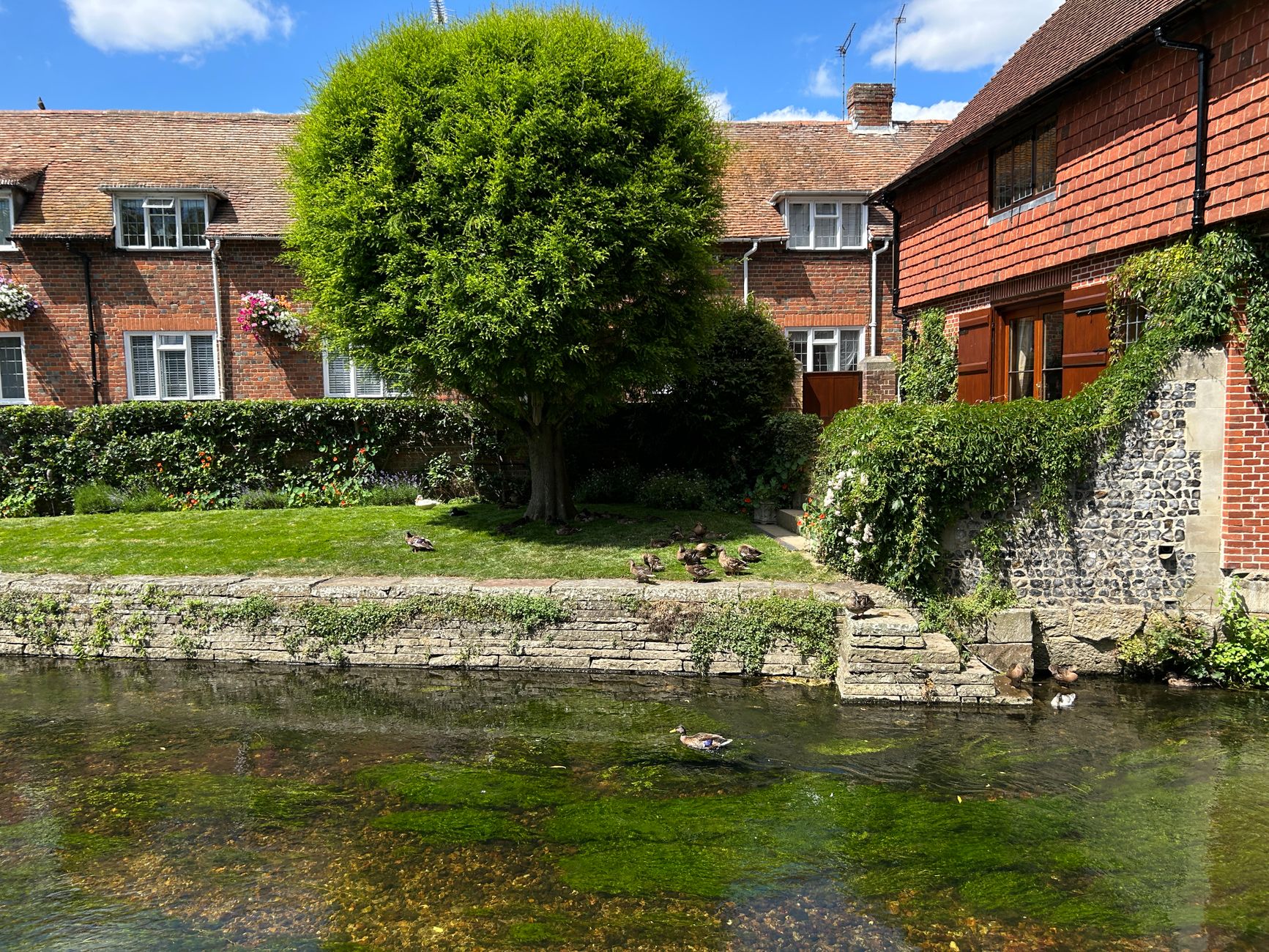
Audrey Hepburn's childhood years in a Kent village
Level
c1
Topic
culture
Read this at a different level:b1
It is tempting to read Audrey Hepburn's later elegance — the poise, the stillness, the quality of attention she brought to every role — as something innate, a gift she arrived with fully formed. What the biographical record suggests, however, is something rather more grounded: that the years she spent in Elham, a quiet village in the Kent countryside, may have shaped her in ways that no amount of subsequent training could replicate. Before the upheaval of the Second World War irrevocably altered her world, Hepburn lived for three years in a place defined by its smallness, its rhythms, and its distance from spectacle.
What makes this period worth examining is not the drama it contains — there is little — but the contrast it offers to the life that followed. Elham, nestled in the rolling landscape of the North Downs, was a village in the most complete sense: a place where daily existence unfolded at a pace dictated by seasons rather than schedules. Historians and biographers who have examined Hepburn's early years have proposed that the village be understood not merely as a backdrop but as a formative environment, one that instilled in her a capacity for quietness that would later distinguish her screen presence from that of her contemporaries.
The timing of her residence there is itself revealing. These were the years immediately preceding the war — a period of surface calm concealing mounting instability across Europe. That a child should have spent them in a Kent village, removed from the metropolitan anxieties of the era, is not incidental. It is essential that any account of Hepburn's development acknowledge this interlude, rather than treating her story as one that begins only with her emergence into public life. The village years were not a prelude to her biography; they were part of its architecture.
Having considered the sparse but suggestive evidence available, one is drawn to a broader reflection: the places that form us rarely announce themselves as formative at the time. Elham did not offer Hepburn a conservatoire, a mentor, or a stage. What it offered was something harder to quantify — an early experience of a world operating below the threshold of noise. Whether that experience was decisive in shaping the particular quality of her presence is, of course, impossible to verify. Nevertheless, those who study the relationship between place and character would insist that such environments be taken seriously as agents of development, not dismissed as mere geographical accident. In Hepburn's case, the village in Kent may have been precisely that: not a footnote, but a foundation.
Highlighted sentences show the grammar focus structure.
Key Vocabulary
innate
/ɪˈneɪt/
Describing a quality or ability that is natural and present from birth, rather than learned or acquired through experience.
Her innate sense of rhythm made her a natural candidate for the conservatoire's most demanding programme.
irrevocably
/ɪˈrɛvəkəbli/
In a way that is permanent and impossible to undo, reverse, or alter.
The industrial accident irrevocably damaged the river ecosystem, which scientists say will never fully recover.
formative
/ˈfɔːrmətɪv/
Having a strong and lasting influence on the development of someone's character, values, or abilities, typically during an early period of life.
The years she spent volunteering abroad proved to be the most formative of her professional life.
instil
/ɪnˈstɪl/
To gradually but firmly establish a quality, belief, or attitude in someone's mind over a period of time.
The rigorous training programme was designed to instil discipline and precision in every recruit.
interlude
/ˈɪntəluːd/
A period of time that interrupts and contrasts with the main course of events, often serving as a pause or transition between more significant phases.
The ceasefire provided a brief interlude of calm before hostilities resumed along the border.
quantify
/ˈkwɒntɪfaɪ/
To express or measure something precisely in numerical or concrete terms, particularly something that is abstract or difficult to assess.
Economists have long struggled to quantify the full social cost of long-term unemployment.
threshold
/ˈθrɛʃhoʊld/
The point or level at which something begins to take effect, become perceptible, or cross into a new condition or category.
The new regulations set a clear threshold below which companies would be exempt from environmental reporting requirements.
backdrop
/ˈbækdrɒp/
The setting or context against which events occur, often one that shapes or colours those events without being their primary focus.
The ongoing financial crisis served as a troubling backdrop to the government's ambitious reform agenda.
| Image | Word | IPA | Definition | Example |
|---|---|---|---|---|
innate | /ɪˈneɪt/ | Describing a quality or ability that is natural and present from birth, rather than learned or acquired through experience. | Her innate sense of rhythm made her a natural candidate for the conservatoire's most demanding programme. | |
irrevocably | /ɪˈrɛvəkəbli/ | In a way that is permanent and impossible to undo, reverse, or alter. | The industrial accident irrevocably damaged the river ecosystem, which scientists say will never fully recover. | |
formative | /ˈfɔːrmətɪv/ | Having a strong and lasting influence on the development of someone's character, values, or abilities, typically during an early period of life. | The years she spent volunteering abroad proved to be the most formative of her professional life. | |
instil | /ɪnˈstɪl/ | To gradually but firmly establish a quality, belief, or attitude in someone's mind over a period of time. | The rigorous training programme was designed to instil discipline and precision in every recruit. | |
interlude | /ˈɪntəluːd/ | A period of time that interrupts and contrasts with the main course of events, often serving as a pause or transition between more significant phases. | The ceasefire provided a brief interlude of calm before hostilities resumed along the border. | |
quantify | /ˈkwɒntɪfaɪ/ | To express or measure something precisely in numerical or concrete terms, particularly something that is abstract or difficult to assess. | Economists have long struggled to quantify the full social cost of long-term unemployment. | |
threshold | /ˈθrɛʃhoʊld/ | The point or level at which something begins to take effect, become perceptible, or cross into a new condition or category. | The new regulations set a clear threshold below which companies would be exempt from environmental reporting requirements. | |
backdrop | /ˈbækdrɒp/ | The setting or context against which events occur, often one that shapes or colours those events without being their primary focus. | The ongoing financial crisis served as a troubling backdrop to the government's ambitious reform agenda. |
Grammar Spotlight
Subjunctive in Formal Contexts
that + subject + bare infinitive
When do we use it?
- Use after verbs of recommendation, demand, or suggestion in formal writing: insist, recommend, propose, require, demand, urge — followed by a 'that' clause.
- Use to convey institutional or official necessity, especially in written registers such as legal documents, academic prose, and formal correspondence.
- Use to signal a high level of formality or precision; in informal speech, 'should + infinitive' or 'ought to' often replaces the subjunctive, so choosing the subjunctive marks register awareness.
How is it formed?
that + subject+bare infinitive (no -s, no auxiliary)
The verb form does NOT change for third-person singular — 'be' stays 'be', not 'is'
★Formal demands? Drop the -s, keep it bare.
See it in action
The committee insisted that every candidate be evaluated on merit alone.
Her director proposed that Hepburn rehearse the scene without any musical accompaniment.
It is essential that the archive remain accessible to future researchers.
The board recommended that she not accept the role until the contract be reviewed.
Remember this
✗The director insisted that she was present at every rehearsal.
✓The director insisted that she be present at every rehearsal.
After verbs of demand or insistence in formal contexts, use the bare subjunctive 'be', not the indicative 'was' or 'is'.
✗It is vital that he attends the ceremony in person.
✓It is vital that he attend the ceremony in person.
The subjunctive requires the bare infinitive — no third-person -s. 'Attends' is indicative; 'attend' is the correct subjunctive form.
✗They recommended that the archive should be preserved indefinitely.
✓They recommended that the archive be preserved indefinitely.
'Should' is an informal substitute for the subjunctive. In formal written English, omit 'should' and use the bare subjunctive directly.
Discussion Questions
- 1.
The article suggests that the places we grow up in shape us in ways we may not recognise until much later. Thinking about the town, city, or region where you spent your childhood, what qualities or values do you think that environment instilled in you — and do you think those qualities have stayed with you into adult life?
- 2.
In your country or culture, how much importance is typically placed on a person's early environment — such as their neighbourhood, rural or urban upbringing, or the pace of life in their community — as an explanation for who they become? Do you think this emphasis is justified, or does it risk oversimplifying the way character develops?
- 3.
The article argues that environments which operate 'below the threshold of noise' — quiet, unhurried, removed from spectacle — can be profoundly formative. To what extent do you agree that stillness and simplicity are valuable conditions for personal development, and how does this sit with the pressures of modern life as you experience them?
- 4.
Biographers often face the challenge of deciding which periods of a person's life are truly significant and which are merely transitional interludes. If you were writing the biography of someone you admire — whether a public figure or someone from your own life — which phase of their story would you argue is most formative, and why?
Comprehension Questions
- 1.
Why do the article's authors argue that Hepburn's time in Elham should be treated as more than a mere backdrop to her life story?
- 2.
What does the timing of Hepburn's residence in Elham reveal about the broader historical context of her early development?
- 3.
How does the article distinguish between what Elham offered Hepburn and what a more conventional path of artistic development might have provided?
- 4.
Is the article's central claim about Elham's influence on Hepburn presented as a proven fact, and what does this tell us about the author's approach to the evidence?
- 5.
Could the article's closing metaphor — describing the village as 'not a footnote, but a foundation' — be said to reflect a broader argument about how we construct biographical narratives?
View answers for the comprehension questions
- 1.The article argues that Elham was not simply a setting against which later events unfolded, but a formative environment that actively shaped Hepburn's character. Biographers and historians propose that the village instilled in her a capacity for quietness that would later define her distinctive screen presence.
- 2.Her years in Elham coincided with the period immediately before the Second World War — a time of surface calm concealing growing instability across Europe. The article suggests that spending this particular period in a rural, removed environment, rather than in a metropolitan setting, was not incidental but essential to understanding her development.
- 3.The article explicitly notes that Elham offered neither a conservatoire, a mentor, nor a stage — the conventional resources associated with artistic training. Instead, it offered something harder to quantify: an early and sustained experience of a world operating below the threshold of noise, which the article implies was more foundational than formal instruction.
- 4.No, the article is careful to acknowledge that the decisive influence of Elham on Hepburn's character cannot be verified. The author adopts a measured, speculative tone — using phrases such as 'may have shaped' and 'impossible to verify' — while still insisting that such environments deserve serious consideration as agents of development rather than being dismissed as geographical accident.
- 5.Yes, the metaphor encapsulates the article's implicit critique of biographies that begin only with a subject's public emergence, treating earlier, quieter periods as peripheral. By repositioning Elham as foundational rather than incidental, the author argues that formative environments which lack obvious drama are frequently undervalued in how we tell the stories of notable lives.
Test your knowledge
Question 1Fill-in-the-blank
The mountains served as a dramatic ____ for the outdoor concert, drawing the audience's gaze even before the performance began.
Question 2Fill-in-the-blank
Some researchers believe that a talent for spatial reasoning is largely ____, present in certain individuals from birth regardless of their educational environment.
Question 3Fill-in-the-blank
The brief ____ between the two demanding projects gave the team just enough time to recover their focus before the next deadline.
Question 4Fill-in-the-blank
The years spent in close contact with experienced colleagues proved to be the most ____ period of her professional life, shaping her approach to problem-solving for decades afterwards.
Question 5Fill-in-the-blank
Once the document had been signed and submitted, the decision was ____ binding, and no further amendments could be made by either party.
View answers for test your knowledge
- 1.backdrop
- 2.innate
- 3.interlude
- 4.formative
- 5.irrevocably
Practice this topic live
Use what you’ve learned in a real 1:1 English conversation with an experienced Talk4Impact tutor.
Practice with tutor