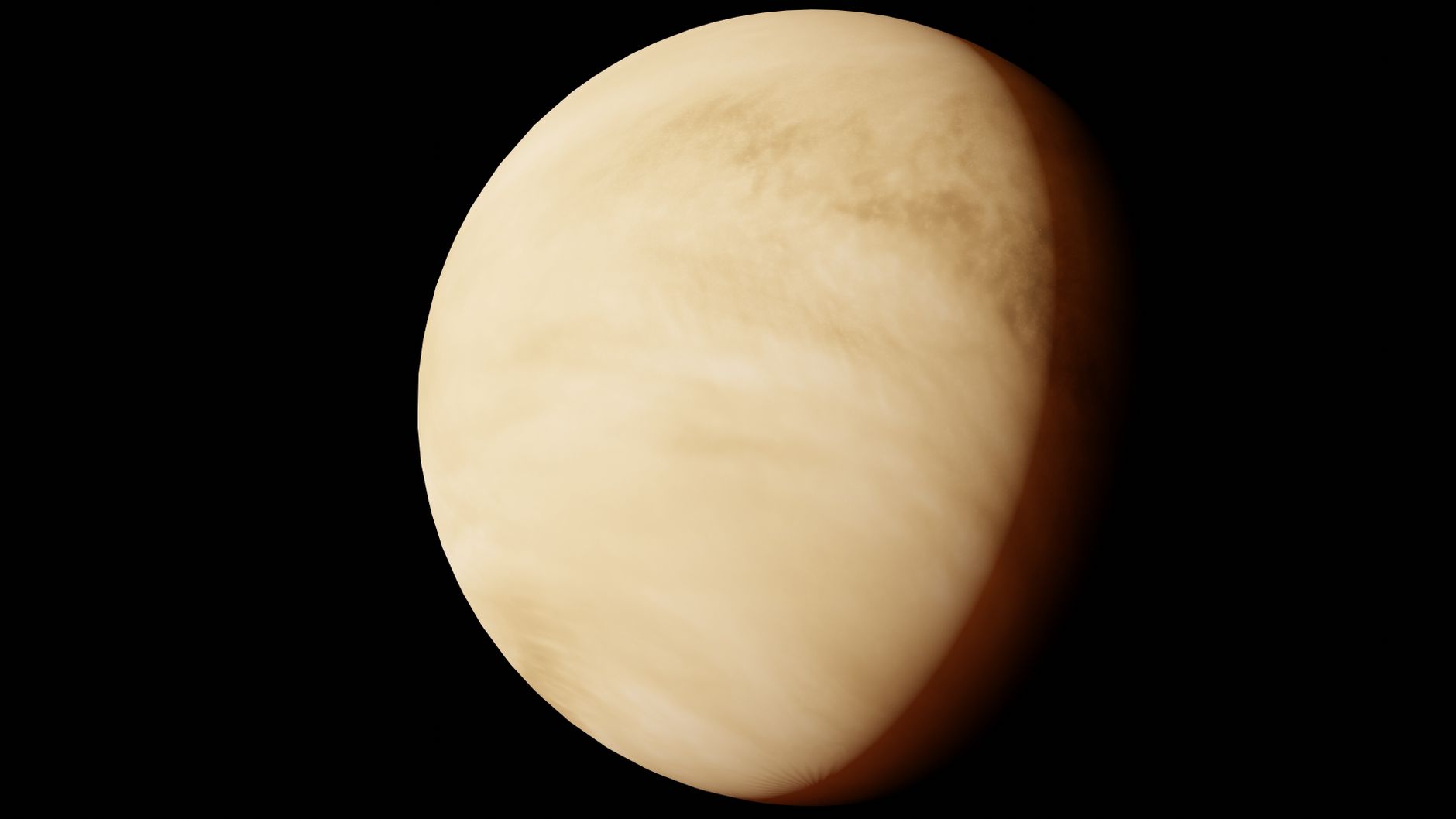
Discovery of an atmosphere on a rocky planet in a habitable zone
Level
c1
Topic
science
Read this at a different level:b1b2
For decades, the search for life beyond our solar system has been shaped by a deceptively simple question: does the planet have an atmosphere? Without one, liquid water cannot persist on a surface, temperatures swing to lethal extremes, and the chemical processes thought to underpin biology have no medium in which to operate. It is precisely this threshold condition that makes a recent astronomical discovery so consequential — researchers have identified an atmosphere on a rocky, Earth-like planet orbiting within the habitable zone of a distant star.
What makes this finding categorically different from previous detections is its combination of planetary type and orbital position. Atmospheres have been detected before, but on gas giants or worlds orbiting far outside the narrow band of stellar distance where liquid water could theoretically exist. This planet sits within that band — close enough to its star to receive sufficient warmth, yet not so close that atmospheric gases would be stripped away by intense radiation. Having confirmed both the planet's rocky composition and its position within the habitable zone, researchers are now confronting a far more complex set of questions about what that atmosphere actually contains.
The distinction matters enormously, because an atmosphere's mere existence tells us relatively little in isolation. A dense envelope of carbon dioxide, for instance, would produce a runaway greenhouse effect rendering the surface uninhabitable — a trajectory Venus followed long ago. Conversely, a thin nitrogen-oxygen mix, analogous to Earth's, would point toward conditions under which liquid water might pool and biological chemistry might, in principle, take hold. What the detection establishes is a starting point, not a conclusion: the planet possesses the structural precondition for habitability, but whether that precondition translates into anything biologically meaningful remains entirely open.
This uncertainty is, arguably, the finding's most intellectually fertile dimension. It challenges the assumption — pervasive in popular accounts of exoplanet research — that identifying a habitable-zone rocky world is itself the discovery. The harder, more consequential work lies in characterising what surrounds it. Atmospheric composition is now the frontier, and the instrumentation required to probe it at interstellar distances is only beginning to reach the necessary resolution. Future observations, conducted over extended periods, will be needed to determine whether the atmosphere's chemical signature bears any resemblance to the biosignatures scientists have theorised might indicate active life.
For now, the planet stands as the first of its kind: a rocky world in a habitable zone confirmed to hold an atmosphere. It is that combination of factors, rather than any single measurement, that has reoriented the field's expectations about where the search for extraterrestrial life should be directed next.
Highlighted sentences show the grammar focus structure.
Key Vocabulary
deceptively
/dɪˈsɛptɪvli/
In a way that creates a false impression, often making something appear simpler, easier, or different from what it actually is.
The exam questions were deceptively straightforward, concealing layers of complexity that caught many candidates off guard.
underpin
/ˌʌndəˈpɪn/
To provide the fundamental basis, support, or justification for something, especially a theory, system, or argument.
A commitment to transparency underpins the organisation's entire approach to corporate governance.
consequential
/ˌkɒnsɪˈkwɛnʃəl/
Having significant or far-reaching importance, especially in terms of the effects or outcomes that follow from something.
The court's ruling was among the most consequential in a generation, reshaping the legal framework for data privacy.
trajectory
/trəˈdʒɛktəri/
The course or path of development that a person, organisation, or situation follows over time.
After the merger, the company's financial trajectory shifted dramatically, moving from consistent losses to sustained profitability.
pervasive
/pəˈveɪsɪv/
Spreading widely and thoroughly throughout a place, group, or system, often to a degree that is difficult to avoid or ignore.
A pervasive culture of short-term thinking in the industry has made it difficult to attract long-term investment.
analogous
/əˈnæləɡəs/
Comparable to something else in function, structure, or position, even if not identical in nature or origin.
The role of the party whip is analogous to that of a team captain, responsible for maintaining discipline and ensuring collective action.
fertile
/ˈfɜːrtaɪl/
Highly productive or conducive to the development of ideas, creativity, or further inquiry; rich in potential.
The interdisciplinary conference proved to be fertile ground for collaborations that would not have emerged within a single academic department.
biosignature
/ˈbaɪoʊˌsɪɡnɪtʃər/
A measurable chemical, physical, or biological indicator whose presence suggests that living organisms exist or have existed in a given environment.
Scientists are developing more sensitive instruments capable of detecting biosignatures in soil samples retrieved from Mars.
| Image | Word | IPA | Definition | Example |
|---|---|---|---|---|
deceptively | /dɪˈsɛptɪvli/ | In a way that creates a false impression, often making something appear simpler, easier, or different from what it actually is. | The exam questions were deceptively straightforward, concealing layers of complexity that caught many candidates off guard. | |
underpin | /ˌʌndəˈpɪn/ | To provide the fundamental basis, support, or justification for something, especially a theory, system, or argument. | A commitment to transparency underpins the organisation's entire approach to corporate governance. | |
consequential | /ˌkɒnsɪˈkwɛnʃəl/ | Having significant or far-reaching importance, especially in terms of the effects or outcomes that follow from something. | The court's ruling was among the most consequential in a generation, reshaping the legal framework for data privacy. | |
trajectory | /trəˈdʒɛktəri/ | The course or path of development that a person, organisation, or situation follows over time. | After the merger, the company's financial trajectory shifted dramatically, moving from consistent losses to sustained profitability. | |
pervasive | /pəˈveɪsɪv/ | Spreading widely and thoroughly throughout a place, group, or system, often to a degree that is difficult to avoid or ignore. | A pervasive culture of short-term thinking in the industry has made it difficult to attract long-term investment. | |
analogous | /əˈnæləɡəs/ | Comparable to something else in function, structure, or position, even if not identical in nature or origin. | The role of the party whip is analogous to that of a team captain, responsible for maintaining discipline and ensuring collective action. | |
fertile | /ˈfɜːrtaɪl/ | Highly productive or conducive to the development of ideas, creativity, or further inquiry; rich in potential. | The interdisciplinary conference proved to be fertile ground for collaborations that would not have emerged within a single academic department. | |
biosignature | /ˈbaɪoʊˌsɪɡnɪtʃər/ | A measurable chemical, physical, or biological indicator whose presence suggests that living organisms exist or have existed in a given environment. | Scientists are developing more sensitive instruments capable of detecting biosignatures in soil samples retrieved from Mars. |
Grammar Spotlight
Cleft Sentences
It is / was + [focus] + that / who + [rest of clause]
When do we use it?
- Use cleft sentences to place emphatic focus on one specific element — subject, object, time, or reason — that you want the listener or reader to treat as new or surprising information.
- Deploy them in formal writing and academic argument to contrast one claim against another, e.g. distinguishing what scientists have found from what they expected to find.
- Use wh-clefts ('What scientists need is...') to frame a topic before elaborating — a sophisticated cohesion device that signals your argument is building toward a key point.
How is it formed?
It is / was+[focused element]+that / who + [remainder of clause]
Use 'who' when the focused element is a person; 'that' for everything else
★Shift the spotlight: It was X that changed everything.
See it in action
It is the presence of an atmosphere that determines whether liquid water can survive on a planet's surface.
It was the discovery of biosignature gases that transformed the search for extraterrestrial life.
What researchers are looking for is not the planet itself, but the chemical fingerprints in its atmosphere.
It is the extreme temperature swings, not the absence of water alone, that make an atmosphereless planet inhospitable.
Remember this
✗It is the atmosphere which determines survival.
✓It is the atmosphere that determines survival.
'Which' is not used in it-cleft constructions; 'that' is the required relative particle, even at C1 level.
✗It was the scientists who discovered the gas that they published their findings.
✓It was the scientists who discovered the gas that published their findings.
Do not repeat the subject pronoun after the cleft clause — the relative clause already carries the subject role.
✗What it is important is the atmospheric composition.
✓What is important is the atmospheric composition.
Wh-clefts begin with 'What + verb phrase'; inserting 'it is' creates a double-cleft error that is ungrammatical.
Discussion Questions
- 1.
In your country, how much public interest or media coverage do scientific discoveries tend to receive? Do you think people where you live are generally engaged with science, or does it feel distant from everyday life?
- 2.
The article argues that the most intellectually fertile questions are often those that open up further uncertainty rather than providing clear answers. Do you personally find that kind of open-ended inquiry motivating or frustrating, and can you think of a time in your own education or career when you encountered a question that led to more questions?
- 3.
If it were confirmed that life — even microbial life — existed elsewhere in the universe, how do you think that discovery would affect people in your culture or community? Would it change deeply held beliefs, or do you think most people would carry on largely unaffected?
- 4.
Governments and international organisations must decide how to allocate funding between space exploration and pressing problems on Earth, such as healthcare or climate change. What is your view on this trade-off, and do you think the priorities in your country currently reflect the right balance?
Comprehension Questions
- 1.
Why does the article describe the question of whether a planet has an atmosphere as 'deceptively simple'?
- 2.
What makes this particular atmospheric detection categorically different from previous ones, according to the article?
- 3.
How does the example of Venus help the author illustrate a key limitation of the discovery?
- 4.
Could the confirmed atmosphere be considered evidence of life on the planet?
- 5.
In what sense does the article suggest that popular accounts of exoplanet research have been misleading, and how does this finding challenge that assumption?
View answers for the comprehension questions
- 1.The question appears straightforward, but it actually encodes a complex set of threshold conditions — without an atmosphere, liquid water cannot persist, temperatures become lethal, and the chemical processes underlying biology have no medium in which to operate. The simplicity of the question masks the profound consequences that hinge on its answer.
- 2.Previous atmospheric detections were made on gas giants or planets orbiting outside the habitable zone, whereas this planet is rocky in composition and sits within the narrow band of stellar distance where liquid water could theoretically exist. It is the combination of planetary type and orbital position that sets this finding apart.
- 3.The author uses Venus to demonstrate that the mere presence of an atmosphere does not guarantee habitability — a dense carbon dioxide envelope can produce a runaway greenhouse effect that renders a surface uninhabitable, which is precisely what happened to Venus. This shows that atmospheric composition, not just existence, is what ultimately determines whether conditions could support life.
- 4.No — the article is explicit that the detection establishes only a structural precondition for habitability, not a conclusion about biology. Whether the atmosphere's chemical signature bears any resemblance to theorised biosignatures remains entirely open and will require far more advanced instrumentation and extended future observations to determine.
- 5.Popular accounts have tended to treat the identification of a habitable-zone rocky world as the discovery itself, implying that finding such a planet is the end goal. The article argues that this assumption is pervasive but misguided, because the harder and more consequential work — characterising the atmosphere's composition and searching for biosignatures — only begins once such a planet is confirmed.
Test your knowledge
Question 1Fill-in-the-blank
The task looked ____ straightforward on paper, but once the team began working through the details, they realised it would take weeks longer than anyone had anticipated.
Question 2Fill-in-the-blank
The years she spent travelling and working in different cities proved to be an extraordinarily ____ period for her creative writing, producing ideas she continued to develop long after she returned home.
Question 3Fill-in-the-blank
A sense of anxiety about the future was ____ among the students during the final weeks before their results were released, affecting concentration and morale across the entire year group.
Question 4Fill-in-the-blank
Once the new director took over, the organisation's ____ shifted dramatically — from cautious, incremental growth to an aggressive strategy of rapid expansion into new markets.
Question 5Fill-in-the-blank
Choosing the wrong supplier at this stage could prove deeply ____, since every subsequent phase of the project depends on the quality and reliability of the materials delivered now.
View answers for test your knowledge
- 1.deceptively
- 2.fertile
- 3.pervasive
- 4.trajectory
- 5.consequential
Practice this topic live
Use what you’ve learned in a real 1:1 English conversation with an experienced Talk4Impact tutor.
Practice with tutor