
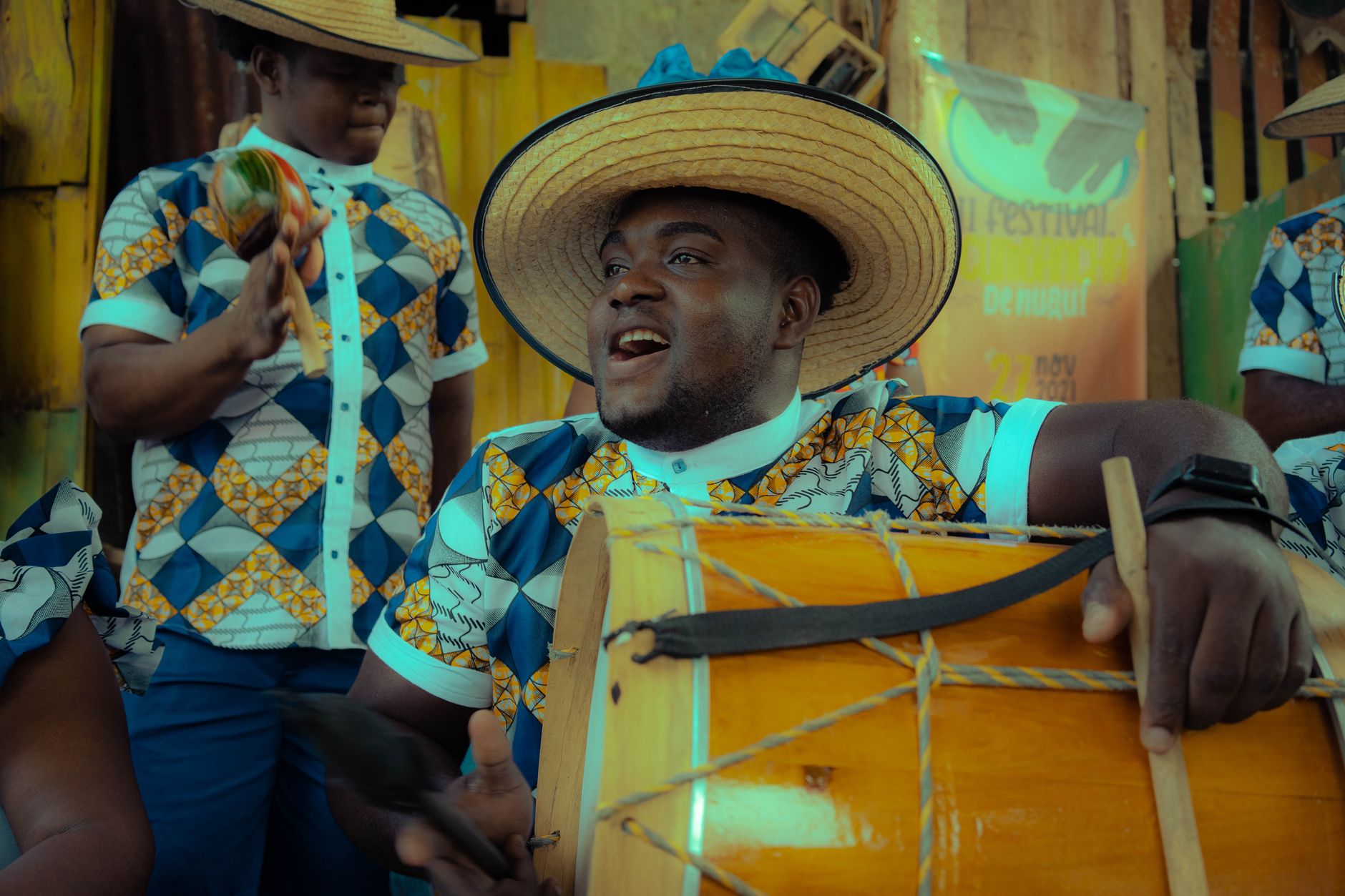
Musician wearing a semi-professional football club shirt at a music festival
Level
c1
Topic
culture
Read this at a different level:a1a2b2
Sorcha had been standing near the main stage at Reading Festival when she noticed it — a flash of unfamiliar blue and white cutting through the crowd of band T-shirts and festival wristbands. Grian Chatten, frontman of Fontaines D.C., was performing in the shirt of a semi-professional football club. It was not a Premier League badge or a globally recognised crest that he had chosen to wear, but the kit of a club most people in that field had never heard of. Sorcha, who follows Fontaines D.C. with the kind of devotion that borders on academic study, found herself reaching for her phone before the first song had finished.
What struck her most in the days that followed was not the performance itself, memorable as it had been, but the commercial ripple that one wardrobe choice had set in motion. The football club, operating at semi-professional level with the modest infrastructure that entails, reported that shirt sales had almost doubled in the aftermath of Chatten's appearance. Sorcha read the coverage with a mixture of amusement and genuine fascination. She had long understood that musicians shape taste — in sound, in language, in aesthetic — but she had not fully reckoned with the extent to which that influence extends into sports merchandise.
It is the specificity of the choice that she keeps returning to. Had Chatten appeared in the shirt of a top-flight club, the gesture would have registered as little more than a casual declaration of allegiance, absorbed into the background noise of celebrity fandom. By selecting a semi-professional club, he directed the gaze of an enormous festival audience toward an institution that would otherwise remain invisible to most of them. Sorcha pointed this out to her flatmate, Dónal, who argued that the effect was essentially the same as an influencer endorsement — except, he added, that nobody had paid for it, which made it arguably more potent.
What the episode reveals is something that the sports and music industries have circled around for years without fully articulating: the boundary between cultural identity and commercial leverage is far more permeable than either side tends to acknowledge. A musician's outfit choice, filtered through the attention economy of a major festival, can function as a distribution mechanism that no marketing budget could reliably replicate. Sorcha found this thought simultaneously exhilarating and slightly unsettling — the idea that a single unrehearsed gesture, worn on a stage, could reshape the fortunes of a club playing its matches in relative obscurity.
Highlighted sentences show the grammar focus structure.
Key Vocabulary
ripple
/ˈrɪpəl/
A series of spreading consequences or effects that follow from a single event or action, often in ways that are difficult to predict.
The closure of the city's largest employer sent a ripple through the local economy, affecting businesses and services far beyond the factory gates.
allegiance
/əˈliːdʒəns/
Loyal commitment or devotion to a person, group, cause, or institution, often expressed publicly or through consistent behaviour.
After decades of supporting the same political party, she began to question where her true allegiance should lie.
potent
/ˈpoʊtənt/
Having a strong or powerful effect, particularly in terms of influence, persuasion, or impact on people's behaviour or beliefs.
The documentary proved to be a potent reminder of how quickly environmental damage can become irreversible.
permeable
/ˈpɜːrmiəbəl/
Allowing ideas, influences, or elements to pass through or across what might otherwise be considered a fixed boundary or barrier.
The boundary between professional and personal life has become increasingly permeable since the widespread adoption of remote working.
leverage
/ˈlevərɪdʒ/
Power or advantage gained through a particular position, resource, or relationship that can be used to achieve a desired outcome.
The union used the threat of a strike as leverage in its negotiations over pay and working conditions.
replicate
/ˈreplɪkeɪt/
To reproduce or copy something, especially a process, result, or effect, in a different context or on a different occasion.
Researchers struggled to replicate the original study's findings under controlled laboratory conditions.
obscurity
/əbˈskjʊərɪti/
The state of being unknown or receiving little public attention, often despite having genuine merit or significance.
The novelist spent thirty years in obscurity before a single review in a national newspaper transformed her career overnight.
entail
/ɪnˈteɪl/
To make something necessary as a consequence or condition; to involve or require something as an inevitable part of a process or situation.
Taking on a leadership role at this level entails a degree of personal sacrifice that many candidates underestimate.
| Image | Word | IPA | Definition | Example |
|---|---|---|---|---|
ripple | /ˈrɪpəl/ | A series of spreading consequences or effects that follow from a single event or action, often in ways that are difficult to predict. | The closure of the city's largest employer sent a ripple through the local economy, affecting businesses and services far beyond the factory gates. | |
allegiance | /əˈliːdʒəns/ | Loyal commitment or devotion to a person, group, cause, or institution, often expressed publicly or through consistent behaviour. | After decades of supporting the same political party, she began to question where her true allegiance should lie. | |
potent | /ˈpoʊtənt/ | Having a strong or powerful effect, particularly in terms of influence, persuasion, or impact on people's behaviour or beliefs. | The documentary proved to be a potent reminder of how quickly environmental damage can become irreversible. | |
permeable | /ˈpɜːrmiəbəl/ | Allowing ideas, influences, or elements to pass through or across what might otherwise be considered a fixed boundary or barrier. | The boundary between professional and personal life has become increasingly permeable since the widespread adoption of remote working. | |
leverage | /ˈlevərɪdʒ/ | Power or advantage gained through a particular position, resource, or relationship that can be used to achieve a desired outcome. | The union used the threat of a strike as leverage in its negotiations over pay and working conditions. | |
replicate | /ˈreplɪkeɪt/ | To reproduce or copy something, especially a process, result, or effect, in a different context or on a different occasion. | Researchers struggled to replicate the original study's findings under controlled laboratory conditions. | |
obscurity | /əbˈskjʊərɪti/ | The state of being unknown or receiving little public attention, often despite having genuine merit or significance. | The novelist spent thirty years in obscurity before a single review in a national newspaper transformed her career overnight. | |
entail | /ɪnˈteɪl/ | To make something necessary as a consequence or condition; to involve or require something as an inevitable part of a process or situation. | Taking on a leadership role at this level entails a degree of personal sacrifice that many candidates underestimate. |
Grammar Spotlight
Cleft Sentences
It is / was + [focus element] + that / who + [rest of clause]
When do we use it?
- Use cleft sentences to place strong emphasis on one specific element — a person, time, place, or reason — that you want the listener or reader to focus on above all else.
- They are especially effective in formal writing, journalism, and persuasive speech to correct a mistaken assumption or to contrast one fact with another ('It wasn't the music that caught her eye — it was the shirt').
- At C1 level, cleft sentences signal sophisticated control of information structure; they allow you to manage what is 'given' versus 'new' information with precision, rather than relying on stress alone.
How is it formed?
It is / was+[focus element]+that / who + [rest of clause]
Use 'who' when the focus element is a person; 'that' for everything else
★Shift the spotlight — put what matters first.
See it in action
It was Grian Chatten who caught Sorcha's attention at the festival.
It was the blue and white shirt that looked so out of place among the band T-shirts.
It was at Reading Festival that she first noticed the unusual kit.
It is the unexpected details that make a live performance truly memorable.
Remember this
Neutral statement (no cleft)
- •Grian Chatten caught Sorcha's attention.
- •The shirt looked out of place.
- •She noticed it at Reading Festival.
Cleft sentence (focused emphasis)
- •It was Grian Chatten who caught Sorcha's attention.
- •It was the shirt that looked out of place.
- •It was at Reading Festival that she noticed it.
The cleft version isolates one element and signals to the reader: this — not anything else — is the key information, often implicitly correcting or contrasting with an alternative.
Discussion Questions
- 1.
In your country, are there musicians, athletes, or public figures whose personal style or choices have visibly influenced what people buy or how they behave? Can you think of a specific example, and what do you think made that influence so effective?
- 2.
The article suggests that an unplanned, unpaid gesture can be more persuasive than a deliberate advertising campaign. Do you find this convincing? In your experience, are you more likely to trust a recommendation that seems spontaneous than one you know has been paid for?
- 3.
Thinking about the sports culture in your country, how important is it for fans to express their allegiance through what they wear or buy? Is this kind of identity-through-merchandise something you personally connect with, or does it feel like something else to you?
- 4.
The article raises the idea that the boundary between cultural identity and commercial leverage is more permeable than we tend to assume. Do you think this blurring of culture and commerce is ultimately a positive development, or does it risk undermining the authenticity of cultural expression? What examples from your own life or context come to mind?
Comprehension Questions
- 1.
Why did the football club's shirt sales nearly double after the Reading Festival performance?
- 2.
What distinction does Sorcha draw between Chatten wearing a semi-professional club's shirt and wearing the shirt of a top-flight club?
- 3.
How does Dónal's comparison to an influencer endorsement both support and complicate Sorcha's analysis of the episode?
- 4.
Is the article's central argument that musicians deliberately exploit their cultural influence for commercial purposes?
- 5.
What does the phrase 'attention economy of a major festival' suggest about how the article understands the relationship between cultural events and commercial outcomes?
View answers for the comprehension questions
- 1.Grian Chatten, the frontman of Fontaines D.C., wore the shirt of the semi-professional club during his set, directing the attention of a large festival audience toward a club that most people would otherwise never have encountered. This unexpected exposure functioned as a form of unpaid endorsement, generating commercial interest that the club's own marketing resources could not have produced.
- 2.Sorcha argues that had Chatten chosen a well-known, top-flight club's shirt, the gesture would have been read as a routine declaration of fan loyalty and would have gone largely unnoticed. By contrast, selecting a semi-professional club's kit made the choice conspicuous and redirected a massive audience's gaze toward an institution that would normally remain invisible to them.
- 3.Dónal agrees with Sorcha that the effect resembles an influencer endorsement in terms of its commercial impact, but he adds a crucial qualification: because no payment was involved, the gesture carries arguably greater persuasive force. This complicates Sorcha's analysis by suggesting that the absence of commercial arrangement may itself be a source of the gesture's power.
- 4.No, the article does not argue that musicians act with deliberate commercial intent. On the contrary, it emphasises that Chatten's wardrobe choice appeared to be an unrehearsed, spontaneous gesture, and the broader point is that even unplanned cultural acts can produce significant commercial consequences — a dynamic that neither the sports nor the music industry has fully come to terms with.
- 5.The phrase implies that a major festival concentrates an enormous volume of audience attention in one place, effectively transforming that attention into a resource that can be directed and exploited. The article suggests that when a cultural act — such as a musician's clothing choice — is filtered through this concentrated attention, it gains a distributional power that conventional marketing budgets cannot reliably reproduce.
Test your knowledge
Question 1Fill-in-the-blank
The border between formal and informal language is surprisingly ____, and skilled writers move between the two registers without readers noticing the shift.
Question 2Fill-in-the-blank
Even a small amount of the compound proved highly ____, producing measurable changes in the subjects' concentration levels within minutes.
Question 3Fill-in-the-blank
The novelist spent decades writing in complete ____, publishing only in small literary journals, before a single prize brought her work to a wide audience.
Question 4Fill-in-the-blank
The decision to restructure the team sent a ____ of uncertainty through the entire organisation, affecting morale in departments that had seemed entirely unrelated to the change.
Question 5Fill-in-the-blank
Having worked in the industry for twenty years, she had considerable ____ in the negotiations and was able to secure terms that a newcomer could never have achieved.
View answers for test your knowledge
- 1.permeable
- 2.potent
- 3.obscurity
- 4.ripple
- 5.leverage
Practice this topic live
Use what you’ve learned in a real 1:1 English conversation with an experienced Talk4Impact tutor.
Practice with tutor