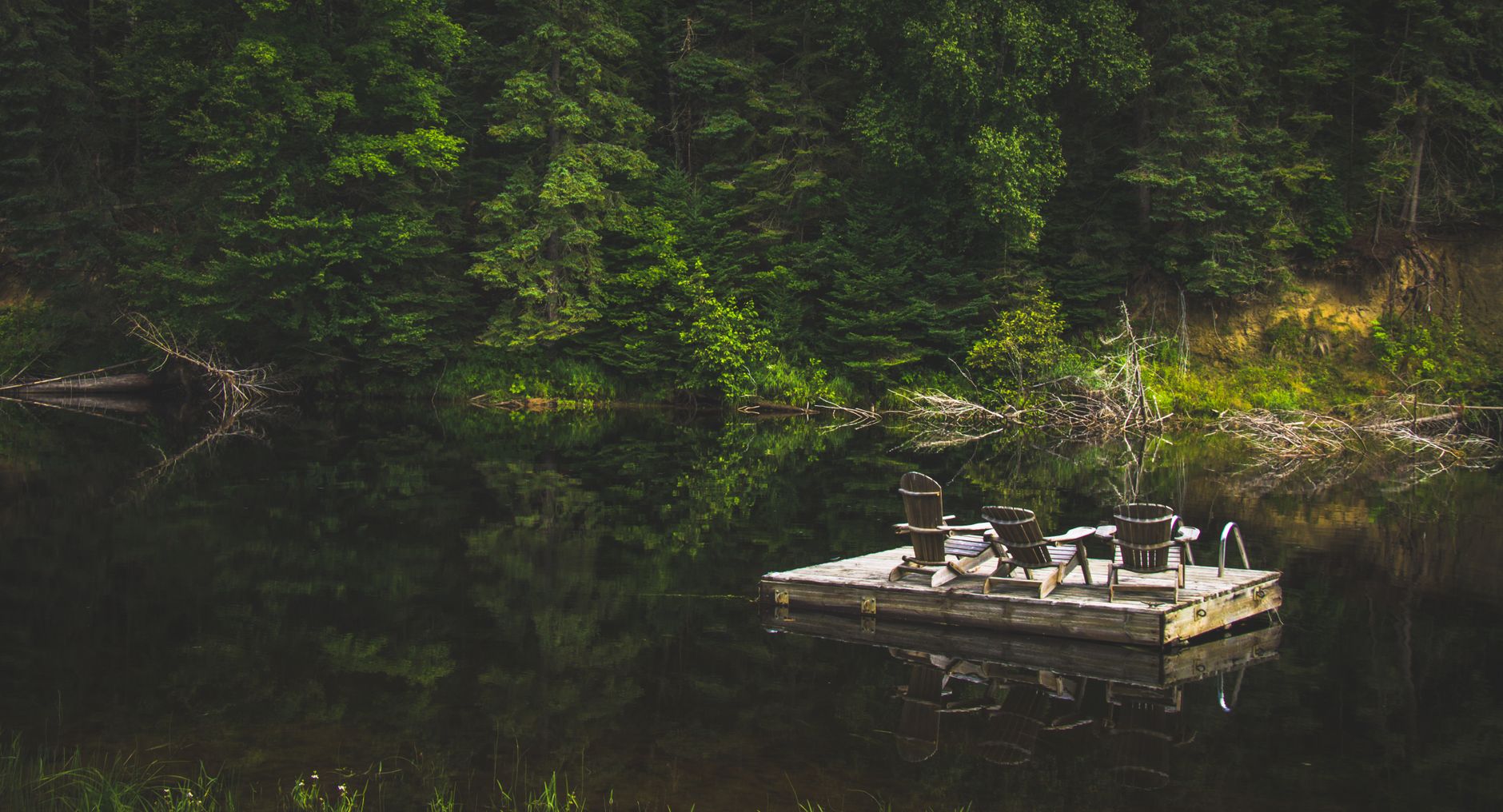
A floating island in a Canadian lake
Level
c1
Topic
science
Read this at a different level:a2b1b2
Most people assume that lakes are defined by their stillness — a fixed boundary between water and land, a shoreline that holds. What a floating island in a British Columbia lake calls into question is precisely that assumption: the boundary, it turns out, can move, and so can the land itself.
The island in question appeared in the lake, vanished, and was subsequently rediscovered after drifting toward the shoreline. Officials confirmed the drift but stopped short of offering any definitive account of its origins. It is that absence of explanation — not the phenomenon itself — that makes this case genuinely arresting. Floating islands are not, in themselves, unheard of; they have been documented across wetland ecosystems worldwide, typically forming when decomposing organic matter accumulates sufficient buoyancy to detach from the lakebed and rise to the surface. What remains unresolved in the British Columbia case, however, is how this particular mass formed, why it disappeared, and what caused it to migrate toward the shore.
The mechanics of floating island formation illuminate a broader tension in how we categorise natural environments. An island, conventionally understood, is stable: it stays where it is. A floating island, by contrast, belongs simultaneously to the water column and to the surface, drifting under the influence of wind, current, and the slow biochemical processes occurring beneath it. Having detached from its original position, such a mass becomes, in effect, a mobile habitat — one that carries whatever vegetation or microfauna has colonised it into entirely new parts of the lake. This is not merely a curiosity; it is a reconfiguration of local ecology in real time.
What the British Columbia case reveals is how readily a single anomalous observation can expose the limits of institutional knowledge. Officials acknowledged the island's reappearance and its movement toward the shoreline, yet its origins remain unknown — a phrase that, in the language of environmental science, carries more weight than it might initially seem. It signals not just a gap in data but a gap in the conceptual frameworks used to monitor and classify lake environments. Rarely do such gaps surface so visibly, in the form of something that can be seen, photographed, and tracked across open water.
The floating island has, for now, come to rest near the shore. Whether it will detach again, dissolve back into the lake, or persist as a stable feature remains to be seen. Its ambiguity, however, is the point: it resists the categories we impose on landscapes, and in doing so, it asks something of the scientists and officials tasked with explaining it.
Highlighted sentences show the grammar focus structure.
Key Vocabulary
arresting
/əˈrɛstɪŋ/
So striking or remarkable as to immediately capture attention and hold it.
The documentary's opening sequence was so arresting that audiences sat in complete silence for several minutes.
buoyancy
/ˈbɔɪənsi/
The capacity of an object or substance to float or rise in a liquid, determined by the upward force exerted by the fluid it displaces.
Engineers tested the buoyancy of the new life vest design by submerging weighted mannequins in a pool.
anomalous
/əˈnɒmələs/
Deviating significantly from what is standard, expected, or typical within a given system or context.
The anomalous temperature readings from the sensor prompted the research team to recalibrate all their instruments.
call into question
/kɔːl ˈɪntə ˈkwɛstʃən/
To cause doubt about the validity, accuracy, or reliability of something previously accepted as true or settled.
The newly discovered financial records called into question the integrity of the entire audit process.
colonise
/ˈkɒlənaɪz/
Of organisms, to establish a population in and spread throughout a new environment or substrate.
Within a decade, the invasive plant species had colonised the entire riverbank, displacing native vegetation.
reconfiguration
/ˌriːkənˌfɪɡəˈreɪʃən/
A fundamental reorganisation of the structure, arrangement, or composition of a system or environment.
The merger required a complete reconfiguration of the company's supply chain and distribution network.
conceptual
/kənˈsɛptʃuəl/
Relating to the abstract ideas, mental frameworks, or theoretical principles used to understand and organise knowledge.
The professor argued that the students' errors were not mathematical but conceptual — they had misunderstood the underlying principle entirely.
persist
/pəˈsɪst/
To continue to exist, remain, or endure over time, especially in the face of conditions that might cause change or dissolution.
Despite repeated negotiations, the trade dispute between the two nations continued to persist well into the following year.
| Image | Word | IPA | Definition | Example |
|---|---|---|---|---|
arresting | /əˈrɛstɪŋ/ | So striking or remarkable as to immediately capture attention and hold it. | The documentary's opening sequence was so arresting that audiences sat in complete silence for several minutes. | |
buoyancy | /ˈbɔɪənsi/ | The capacity of an object or substance to float or rise in a liquid, determined by the upward force exerted by the fluid it displaces. | Engineers tested the buoyancy of the new life vest design by submerging weighted mannequins in a pool. | |
anomalous | /əˈnɒmələs/ | Deviating significantly from what is standard, expected, or typical within a given system or context. | The anomalous temperature readings from the sensor prompted the research team to recalibrate all their instruments. | |
call into question | /kɔːl ˈɪntə ˈkwɛstʃən/ | To cause doubt about the validity, accuracy, or reliability of something previously accepted as true or settled. | The newly discovered financial records called into question the integrity of the entire audit process. | |
colonise | /ˈkɒlənaɪz/ | Of organisms, to establish a population in and spread throughout a new environment or substrate. | Within a decade, the invasive plant species had colonised the entire riverbank, displacing native vegetation. | |
reconfiguration | /ˌriːkənˌfɪɡəˈreɪʃən/ | A fundamental reorganisation of the structure, arrangement, or composition of a system or environment. | The merger required a complete reconfiguration of the company's supply chain and distribution network. | |
conceptual | /kənˈsɛptʃuəl/ | Relating to the abstract ideas, mental frameworks, or theoretical principles used to understand and organise knowledge. | The professor argued that the students' errors were not mathematical but conceptual — they had misunderstood the underlying principle entirely. | |
persist | /pəˈsɪst/ | To continue to exist, remain, or endure over time, especially in the face of conditions that might cause change or dissolution. | Despite repeated negotiations, the trade dispute between the two nations continued to persist well into the following year. |
Grammar Spotlight
Cleft Sentences
It is/was + [focus] + that/who + [rest of clause]
When do we use it?
- Use cleft sentences to foreground a specific element — subject, object, time, or reason — that you want the listener or reader to treat as new or surprising information.
- Deploy them to correct or challenge an assumption already in play, making your counter-claim feel precise and emphatic rather than blunt.
- At C1 level, exploit wh-clefts ('What the data reveals is…') for a more formal, analytical register — common in academic writing and sophisticated argumentation.
How is it formed?
It is / It was + [focused element]+that / who + [remainder of clause]
Use 'who' when the focused element is a person; 'that' for everything else
★Shift the spotlight: It was X that changed everything.
See it in action
It is the boundary itself that moves, not the water.
What the floating island calls into question is our assumption that land is fixed.
It was the shoreline's apparent stillness that misled researchers for decades.
What a shifting island reveals is that even the most stable-looking landscapes can deceive us.
Remember this
✗It is the boundary that it moves.
✓It is the boundary that moves.
Do not repeat the subject pronoun after 'that'. The cleft clause already contains the verb — adding a second subject creates a double-subject error.
✗What the island calls into question are our assumptions.
✓What the island calls into question is our assumptions.
The verb after the wh-cleft pivot must agree with the complement noun phrase. 'What…' clauses take a singular verb ('is') regardless of whether the complement is plural.
✗It was the boundary which moved, not the water.
✓It is the boundary that moves, not the water.
Using 'which' in an it-cleft is non-standard in modern English; 'that' is the correct relativiser here. Also, match tense to the intended time frame — avoid defaulting to past tense when the situation is still true.
Discussion Questions
- 1.
The article describes a natural phenomenon that defied easy classification and left scientists without a clear explanation. In your experience, how do institutions or authorities in your country typically respond when they encounter something they cannot explain — do they tend to acknowledge uncertainty openly, or is there pressure to provide answers quickly? What do you think is the more responsible approach?
- 2.
The floating island is described as something that 'resists the categories we impose on landscapes.' Do you think human beings have a tendency to oversimplify the natural world in order to manage or understand it? Can you think of examples from your own country or region where nature has behaved in ways that challenged official or popular assumptions about how environments work?
- 3.
The article raises the idea that a single anomalous observation can reveal the limits of an entire system of knowledge. In your own life or professional experience, have you ever encountered a situation where one unexpected event forced you or those around you to completely rethink an assumption you had all taken for granted? What did that experience teach you?
- 4.
Lakes, rivers, and other bodies of water often hold cultural or symbolic significance for communities around the world. Are there particular bodies of water in your country or region that carry special meaning for local people — and do you think that cultural attachment makes it harder or easier for communities to accept scientific explanations when something unusual happens to those environments?
Comprehension Questions
- 1.
Why does the author argue that the absence of explanation is more significant than the floating island phenomenon itself?
- 2.
How does a floating island differ from a conventional island in terms of its ecological role, according to the article?
- 3.
What physical and chemical processes does the article identify as responsible for the formation of floating islands in general?
- 4.
Could the phrase 'origins remain unknown' be read as a straightforward admission of ignorance, or does the article suggest it carries deeper implications?
- 5.
What does the article imply about the relationship between anomalous natural observations and institutional knowledge, drawing on both the third and fourth paragraphs?
View answers for the comprehension questions
- 1.The author suggests that floating islands are a documented natural occurrence worldwide, so the phenomenon alone is not remarkable. What makes this case genuinely arresting is that officials could not account for how the island formed, why it disappeared, or what caused it to move — exposing a gap not just in data but in the conceptual frameworks used to understand lake environments.
- 2.Unlike a conventional island, which remains fixed in place, a floating island drifts under the influence of wind, current, and biochemical processes, effectively becoming a mobile habitat. This means it can transport whatever vegetation or microfauna has colonised it into entirely new parts of the lake, causing a real-time reconfiguration of local ecology.
- 3.The article explains that floating islands typically form when decomposing organic matter accumulates enough buoyancy to detach from the lakebed and rise to the surface. This is a process documented across wetland ecosystems worldwide, though the specific origins of the British Columbia island remain unknown.
- 4.The article argues that the phrase carries considerably more weight than a simple admission of ignorance. In the language of environmental science, it signals not only a gap in data but a failure in the conceptual frameworks that scientists and officials use to monitor and classify lake environments — a more fundamental kind of limitation.
- 5.The article implies that anomalous observations like the floating island have the capacity to expose the limits of institutional knowledge in unusually visible ways. While officials could confirm the island's reappearance and movement, they could not explain it, suggesting that the frameworks used to monitor lake environments are not equipped to account for phenomena that resist standard categories.
Test your knowledge
Question 1Fill-in-the-blank
Despite the harsh conditions and repeated setbacks, the team's determination to succeed managed to ____ throughout the entire duration of the project.
Question 2Fill-in-the-blank
Within just a few years of the building being abandoned, wild plants had begun to ____ every floor, spreading through cracks in the concrete and taking over entire rooms.
Question 3Fill-in-the-blank
The speaker's opening remarks were so ____ that the entire audience fell silent within seconds, completely drawn in before she had finished her first sentence.
Question 4Fill-in-the-blank
The professor warned her students that without a solid ____ framework, it is almost impossible to interpret experimental data in a meaningful or consistent way.
Question 5Fill-in-the-blank
The arrival of new leadership led to a complete ____ of the organisation's internal structure, with teams, responsibilities, and reporting lines all fundamentally changed.
View answers for test your knowledge
- 1.persist
- 2.colonise
- 3.arresting
- 4.conceptual
- 5.reconfiguration
Practice this topic live
Use what you’ve learned in a real 1:1 English conversation with an experienced Talk4Impact tutor.
Practice with tutor