
Conservation project for rare bumblebees in the UK
Level
c1
Topic
environment
Read this at a different level:b2
Conservation efforts rarely succeed by targeting a species in isolation. What the new Moss carder bumblebee programme in the UK appears to understand — and what distinguishes it from earlier, piecemeal interventions — is that the survival of a rare pollinator is inseparable from the broader fate of the habitats that sustain it. If conservationists had recognised this interdependence two decades ago, the Moss carder bumblebee would now be far less vulnerable across its remaining range.
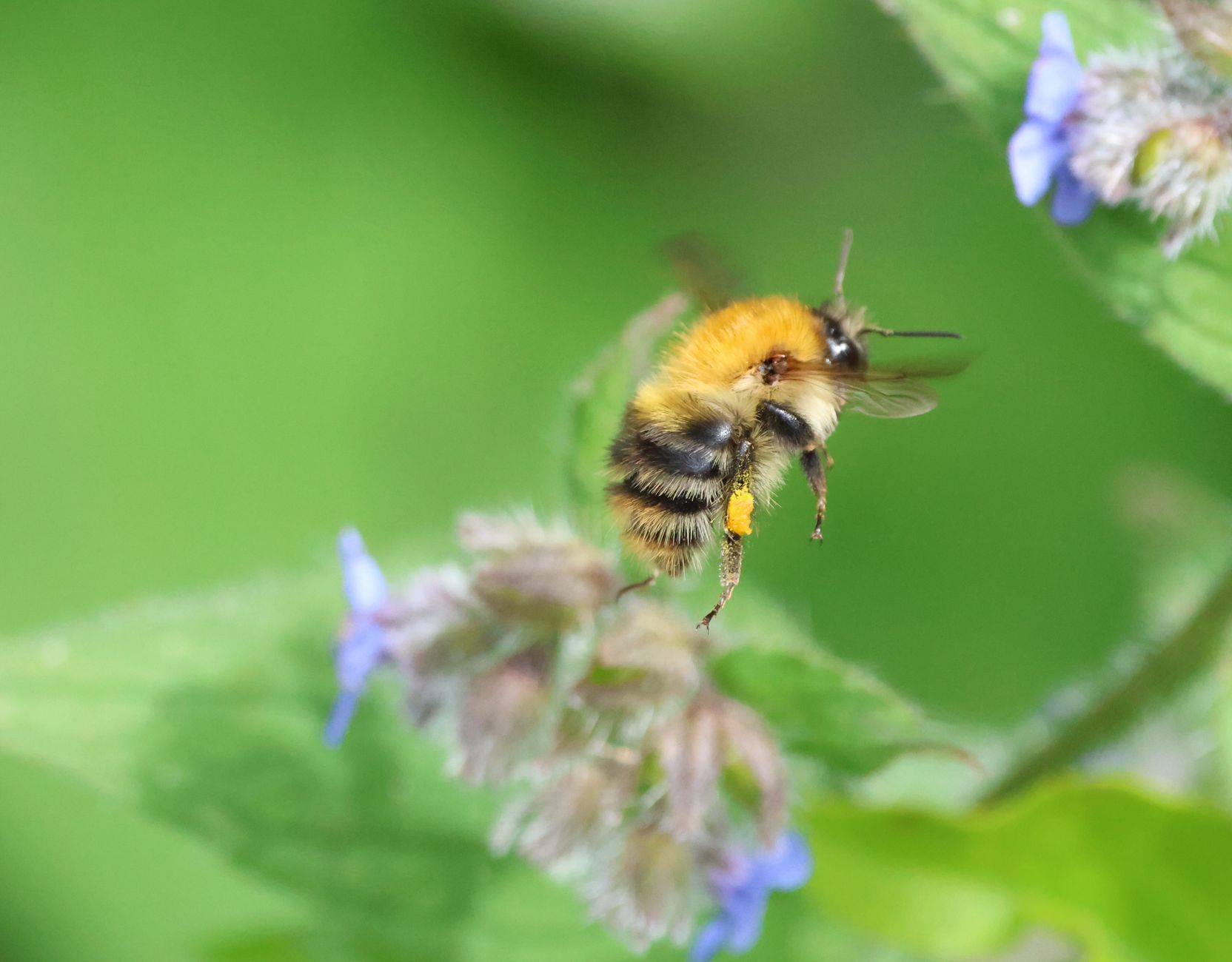
The Moss carder bumblebee, one of the UK's rarer species, is the focus of a newly launched conservation programme targeting three distinct regions: Cornwall in the southwest, Kent in the southeast, and the North Pennines further north. The geographical spread of this initiative is itself analytically telling. Rather than concentrating resources in a single stronghold, the programme distributes its attention across ecologically varied landscapes, acknowledging that no single region can bear the full burden of a species' recovery. What this approach challenges is the assumption — still pervasive in conservation discourse — that rarity is best addressed through containment rather than dispersal.
Having identified these three regions as priority areas, those behind the programme face a challenge that is at once ecological and institutional: how to coordinate land management, habitat restoration, and community engagement across sites that share a species but little else in terms of landscape character. Cornwall's coastal grasslands, Kent's agricultural margins, and the moorland expanses of the North Pennines present different pressures and different opportunities. Rarely does a single conservation framework translate cleanly across such varied terrain, and the programme's architects will need to calibrate their interventions accordingly.
The deeper tension here is one that runs through pollinator conservation as a whole. Bumblebees are not merely charismatic subjects for public engagement — they are functional components of ecosystems on which food production and wild plant communities depend. If the habitats needed to sustain the Moss carder bee had not been fragmented so extensively over the past century, there would now be far less urgency surrounding the species' protection. The programme's existence is, in a sense, a reckoning with the cumulative consequences of land-use decisions made long before the species' decline became measurable.
Nevertheless, the initiative represents a meaningful attempt to reverse trajectories that have long seemed intractable. Whether its three-region structure proves adequate to the scale of the challenge remains to be seen. What is already clear is that the Moss carder bumblebee's fate will serve as a test case — not merely for this programme, but for the broader proposition that targeted, geographically distributed conservation can arrest the attrition of species that have already lost so much ground.
Highlighted sentences show the grammar focus structure.
Key Vocabulary
piecemeal
/ˈpiːsmiːl/
Done or implemented gradually in separate stages or parts, rather than as part of a coherent overall plan.
The government's piecemeal approach to healthcare reform left many systemic problems unaddressed.
pervasive
/pəˈveɪsɪv/
Spreading widely and present throughout every part of something, often in a way that is difficult to avoid or eliminate.
A pervasive sense of distrust had settled over the organisation following the financial scandal.
calibrate
/ˈkælɪbreɪt/
To carefully adjust or fine-tune an approach, instrument, or plan to achieve the most accurate or appropriate result in a given situation.
The policy team had to calibrate their messaging carefully to avoid alienating key stakeholders.
fragmented
/ˈfræɡməntɪd/
Broken into disconnected or isolated parts, so that a formerly unified whole no longer functions or exists as one.
The fragmented nature of the city's transport network made commuting unnecessarily complicated.
intractable
/ɪnˈtræktəbəl/
Describing a problem or situation that is extremely difficult to manage, resolve, or change, despite sustained effort.
Poverty in the region had long been considered an intractable problem, resistant to conventional policy solutions.
trajectory
/trəˈdʒektəri/
The path or course of development that something follows over time, particularly in terms of its progress or direction of change.
Her early career trajectory suggested she would reach a senior leadership role within a decade.
attrition
/əˈtrɪʃən/
A gradual and sustained reduction in the strength, number, or effectiveness of something through continuous pressure or loss over time.
Staff attrition at the firm had reached alarming levels, with one in five employees leaving each year.
reckoning
/ˈrekənɪŋ/
A moment of confronting the consequences of past actions or decisions, often implying a sense of accountability or judgment.
The audit triggered a reckoning within the department over how funds had been managed for years.
| Image | Word | IPA | Definition | Example |
|---|---|---|---|---|
piecemeal | /ˈpiːsmiːl/ | Done or implemented gradually in separate stages or parts, rather than as part of a coherent overall plan. | The government's piecemeal approach to healthcare reform left many systemic problems unaddressed. | |
pervasive | /pəˈveɪsɪv/ | Spreading widely and present throughout every part of something, often in a way that is difficult to avoid or eliminate. | A pervasive sense of distrust had settled over the organisation following the financial scandal. | |
calibrate | /ˈkælɪbreɪt/ | To carefully adjust or fine-tune an approach, instrument, or plan to achieve the most accurate or appropriate result in a given situation. | The policy team had to calibrate their messaging carefully to avoid alienating key stakeholders. | |
fragmented | /ˈfræɡməntɪd/ | Broken into disconnected or isolated parts, so that a formerly unified whole no longer functions or exists as one. | The fragmented nature of the city's transport network made commuting unnecessarily complicated. | |
intractable | /ɪnˈtræktəbəl/ | Describing a problem or situation that is extremely difficult to manage, resolve, or change, despite sustained effort. | Poverty in the region had long been considered an intractable problem, resistant to conventional policy solutions. | |
trajectory | /trəˈdʒektəri/ | The path or course of development that something follows over time, particularly in terms of its progress or direction of change. | Her early career trajectory suggested she would reach a senior leadership role within a decade. | |
attrition | /əˈtrɪʃən/ | A gradual and sustained reduction in the strength, number, or effectiveness of something through continuous pressure or loss over time. | Staff attrition at the firm had reached alarming levels, with one in five employees leaving each year. | |
reckoning | /ˈrekənɪŋ/ | A moment of confronting the consequences of past actions or decisions, often implying a sense of accountability or judgment. | The audit triggered a reckoning within the department over how funds had been managed for years. |
Grammar Spotlight
Mixed Conditionals
If + past perfect … would + infinitive / If + past simple … would have + past participle
When do we use it?
- Use a mixed conditional when the condition and the result belong to different time frames — for example, a past event that still shapes the present, or a present state that would have changed a past outcome.
- They allow you to express nuanced counterfactual reasoning: 'If that policy had been adopted years ago, conservation funding would look very different today.'
- At C1 level, mixed conditionals signal sophisticated argument — use them to connect historical decisions to current realities, especially in academic writing or formal discussion.
How is it formed?
If + past perfect, … would + bare infinitive+If + past simple, … would have + past participle
Type 1 links a past condition to a present result; Type 2 links a present/permanent condition to a past result.
★Mix the times — past cause, present effect (or vice versa)
See it in action
If the UK government had invested in wildflower meadows decades ago, pollinator populations would be far healthier now.
The Moss carder bumblebee would have recovered sooner if conservationists understood ecosystems as interconnected wholes.
If earlier programmes had not treated species in isolation, we would still have a much richer biodiversity today.
If habitat loss were not so severe, the new bumblebee programme would have had a much stronger foundation to build on.
Remember this
✗If they had protected the habitat, the bees would have been thriving now.
✓If they had protected the habitat, the bees would be thriving now.
When the result refers to the present moment, use 'would + bare infinitive' (or continuous), not 'would have + past participle'.
✗If funding wasn't so limited today, the programme would have launched earlier.
✓If funding weren't so limited today, the programme would have launched earlier.
For a present/hypothetical condition in a mixed conditional, use the subjunctive 'were' (not 'was') in formal and written registers at C1 level.
✗If the species would have survived, conservation methods would be different now.
✓If the species had survived, conservation methods would be different now.
Never use 'would have' in the if-clause. The past perfect belongs in the condition; 'would' belongs only in the result clause.
Discussion Questions
- 1.
In your country, are there any native animal or plant species that are considered endangered or under threat? What do you think has caused their decline, and how does your government or local community respond to the issue?
- 2.
The article suggests that conservation efforts often fail when they treat a species in isolation rather than addressing the broader ecosystem. Do you think this kind of systemic, long-term thinking is generally valued in the way decisions are made in your country — whether in environmental policy, urban planning, or another field? What examples come to mind?
- 3.
To what extent do you believe individuals have a moral responsibility to change their behaviour — for example, in how they consume food or use land — in order to protect biodiversity? Where would you draw the line between personal responsibility and the duty of governments or corporations?
- 4.
The article frames the Moss carder bumblebee programme as a 'test case' for whether geographically distributed conservation can work at scale. If you were advising policymakers on how to design such a programme in your own country, what factors would you prioritise, and what obstacles do you think would be hardest to overcome?
Comprehension Questions
- 1.
Why does the article suggest that the Moss carder bumblebee's situation would be less critical today if conservationists had acted differently two decades ago?
- 2.
What is analytically significant about the decision to target three geographically distinct regions rather than concentrating resources in one location?
- 3.
How does the article characterise the challenge facing those who designed the programme once the three priority regions had been identified?
- 4.
Is the article's overall tone towards the programme optimistic, and what evidence from the final two paragraphs supports your reading?
- 5.
Could the programme's existence itself be interpreted as an indictment of past land-use policy, and how does the article frame this idea?
View answers for the comprehension questions
- 1.The article argues that earlier recognition of the interdependence between the species and its habitats would have led to more effective, timely intervention. Because this systemic understanding was absent, the bumblebee has become far more vulnerable across its remaining range.
- 2.The three-region approach challenges the prevailing assumption that rarity is best managed through containment in a single stronghold. By distributing attention across ecologically varied landscapes, the programme acknowledges that no single region can shoulder the full responsibility for a species' recovery.
- 3.The challenge is described as simultaneously ecological and institutional — the programme must coordinate land management, habitat restoration, and community engagement across sites that share a species but differ substantially in landscape character, pressures, and opportunities. A single conservation framework is unlikely to translate cleanly across Cornwall's coastal grasslands, Kent's agricultural margins, and the North Pennines' moorland.
- 4.The tone is cautiously measured rather than straightforwardly optimistic. While the article acknowledges the initiative as a 'meaningful attempt to reverse trajectories that have long seemed intractable,' it withholds full confidence by noting that whether the three-region structure proves adequate 'remains to be seen,' framing the programme as a test case whose outcome is genuinely uncertain.
- 5.Yes — the article explicitly describes the programme's existence as 'a reckoning with the cumulative consequences of land-use decisions made long before the species' decline became measurable.' This framing positions the conservation initiative not merely as a forward-looking remedy but as an acknowledgement of accountability for historical habitat fragmentation.
Test your knowledge
Question 1Fill-in-the-blank
Before launching the new training initiative, the team spent several weeks working to ____ their approach so that it would suit the specific needs and skill levels of each department.
Question 2Fill-in-the-blank
The young athlete's career had followed an impressive ____, moving steadily from local competitions to national championships within just three years.
Question 3Fill-in-the-blank
Years of budget cuts led to a gradual ____ of the research department's capacity, until only a handful of specialists remained.
Question 4Fill-in-the-blank
The renovation of the old library was carried out in a ____ fashion over several years, with different sections updated at different times rather than as part of a unified plan.
Question 5Fill-in-the-blank
After years of ignoring the warnings, the organisation finally faced a ____ when the full extent of its financial mismanagement became public.
View answers for test your knowledge
- 1.calibrate
- 2.trajectory
- 3.attrition
- 4.piecemeal
- 5.reckoning
Practice this topic live
Use what you’ve learned in a real 1:1 English conversation with an experienced Talk4Impact tutor.
Practice with tutor