
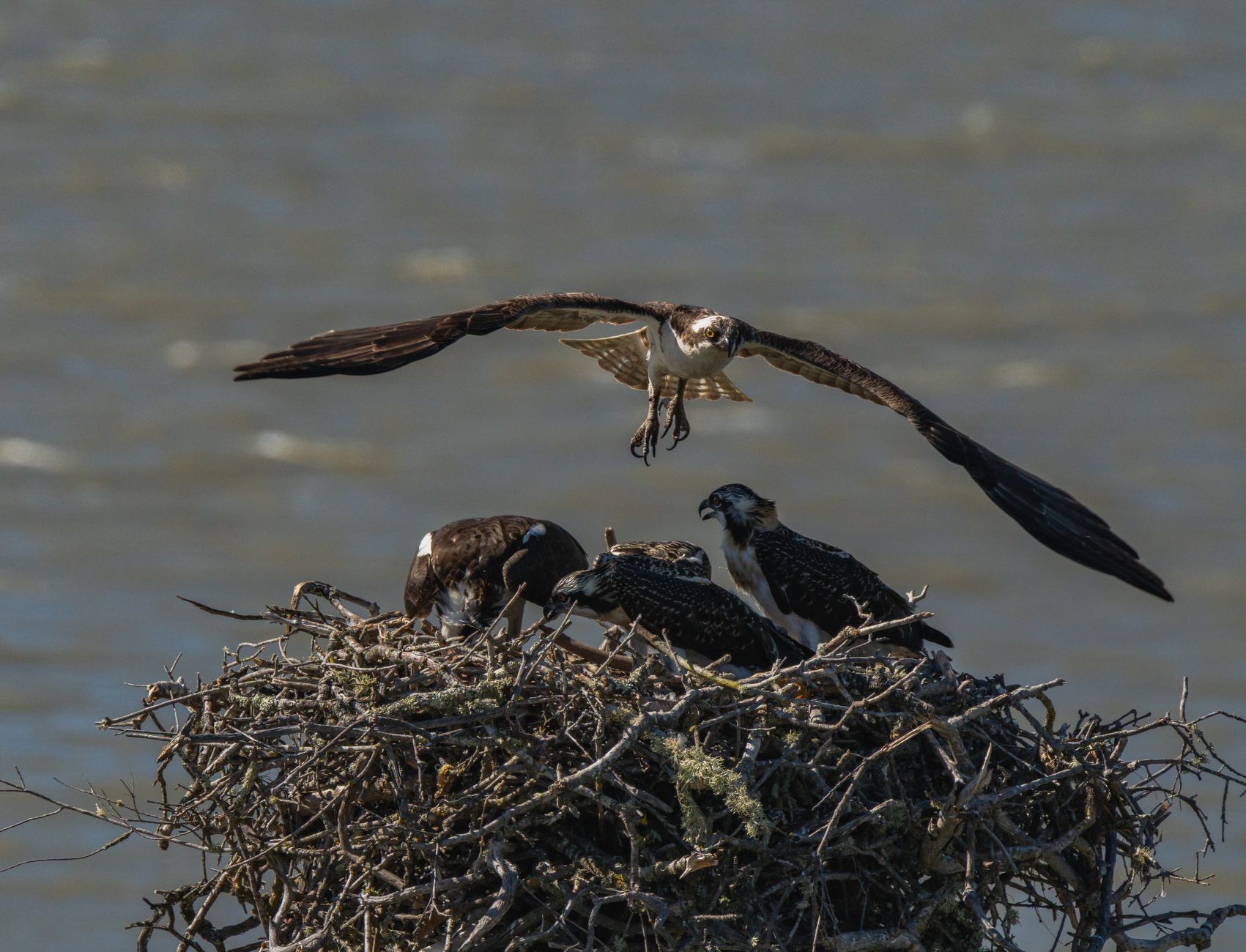
Juvenile ospreys leaving the nest near Wareham
Level
a1
Topic
environment
Read this at a different level:b2c1
My friend Clara lives near Wareham. She loves birds. Last week, she called me with good news. "The first young osprey left its nest!" she said.
Clara's favourite bird is the osprey. She walks near Wareham every week. She looks at the birds near the water. The nest is in a tall tree. Clara says the nest is very big.
This year, four young ospreys are in the nest. The first one left this week. Clara's phone has many photos of the birds. She is very happy. She wants to see all four birds fly.
Highlighted sentences show the grammar focus structure.
Key Vocabulary
friend
/frɛnd/
A person you like and enjoy spending time with.
My friend and I eat lunch together at school every day.
nest
/nɛst/
The home that a bird makes to keep its eggs and babies safe.
I can see a small nest in the tree outside my window.
photo
/ˈfoʊtoʊ/
A picture you take with a camera or phone.
She took a photo of her family at the park.
happy
/ˈhæpi/
Feeling good and pleased about something.
The children are very happy because today is their birthday.
walk
/wɔːk/
To move on your feet from one place to another.
I walk to school every morning with my brother.
| Image | Word | IPA | Definition | Example |
|---|---|---|---|---|
friend | /frɛnd/ | A person you like and enjoy spending time with. | My friend and I eat lunch together at school every day. | |
nest | /nɛst/ | The home that a bird makes to keep its eggs and babies safe. | I can see a small nest in the tree outside my window. | |
photo | /ˈfoʊtoʊ/ | A picture you take with a camera or phone. | She took a photo of her family at the park. | |
happy | /ˈhæpi/ | Feeling good and pleased about something. | The children are very happy because today is their birthday. | |
walk | /wɔːk/ | To move on your feet from one place to another. | I walk to school every morning with my brother. |
Grammar Spotlight
Present Simple — Ordinary Verbs
subject + verb (+ -s / -es for he / she / it)
When do we use it?
- Use it to talk about things that happen regularly or as a habit — for example, every day, every week.
- Use it to talk about facts that are always true — for example, where someone lives or what they like.
- Use it to describe what a person or thing does in general, not just right now.
How is it formed?
subject+base verb (+ -s / -es for he / she / it)+rest of sentence
Add -s or -es only when the subject is he, she, or it.
★He/she/it? Don't forget the -s!
See it in action
Clara walks near Wareham every week.
She looks at the birds near the water.
The osprey lives in a tall tree.
I love birds and I watch them every morning.
Remember this
✗She walk near Wareham every week.
✓She walks near Wareham every week.
With he, she, or it, you must add -s to the verb.
✗He don't like birds.
✓He doesn't like birds.
Use doesn't (not don't) to make a negative sentence with he, she, or it.
✗Clara is walk to the river.
✓Clara walks to the river.
For habits and routines, use the present simple — not is + verb-ing.
Discussion Questions
- 1.
Do you like birds? What birds do you see near your home?
- 2.
Where do you go for a walk in your city or town?
- 3.
Do people in your country take photos of animals or nature? What do they take photos of?
Comprehension Questions
- 1.
Who called Clara with good news?
- 2.
Where is the osprey nest?
- 3.
What does Clara have on her phone?
- 4.
When did the first osprey leave?
View answers for the comprehension questions
- 1.Clara called her friend with the good news. She phoned to say the first young osprey had left its nest.
- 2.The nest is in a tall tree near Wareham. Clara says the nest is very big.
- 3.Clara has many photos of the birds on her phone.
- 4.The first young osprey left its nest last week, the same week Clara called her friend with the news.
Test your knowledge
Question 1Fill-in-the-blank
The small bird built a ____ in the tree outside the window.
Question 2Fill-in-the-blank
She was very ____ when she passed her exam.
Question 3Fill-in-the-blank
He took a ____ of the mountains with his phone.
View answers for test your knowledge
- 1.nest
- 2.happy
- 3.photo
Practice this topic live
Use what you’ve learned in a real 1:1 English conversation with an experienced Talk4Impact tutor.
Practice with tutor