
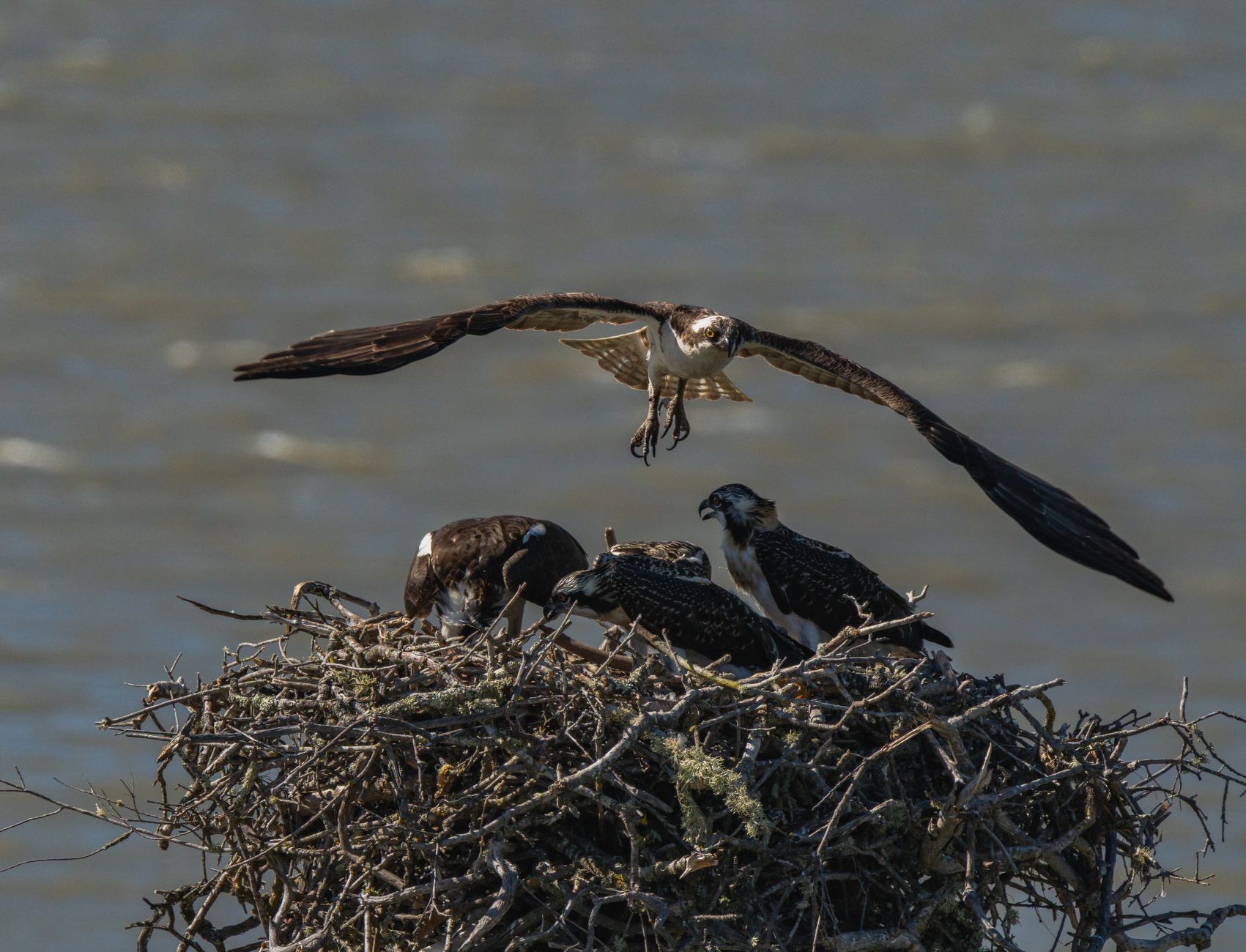
Juvenile ospreys leaving the nest near Wareham
Level
c1
Topic
environment
Read this at a different level:a1b2
Every summer, the wetlands and river corridors of southern England hold their breath for a particular moment: the first juvenile osprey of the season stepping off the edge of its nest and trusting the air beneath its wings. This year, that moment has already arrived near Wareham, in Dorset, where the first of what is expected to be four juvenile ospreys has fledged. What makes this event worth examining is not merely the spectacle of a large raptor taking flight for the first time, but what it reveals about one of the more quietly consequential conservation recoveries in British natural history.
Ospreys were absent from England as breeding birds for the better part of a century, driven out by persecution and habitat loss. Their gradual return — first to Scotland, then to Wales, and now to sites in England — has been the result of sustained, deliberate stewardship rather than unaided natural recovery. It is the cumulative effort of conservationists, landowners, and monitoring volunteers that has made nesting sites near Wareham viable at all. The nest itself, positioned to offer access to the fish-rich waterways of the Frome valley, did not materialise by accident; it represents years of habitat management and careful site selection.
Having established a foothold in the area over recent seasons, the local osprey population now faces what ecologists regard as the most precarious phase of the annual cycle: fledging. Juvenile ospreys must learn to hunt fish independently within weeks of leaving the nest, and the failure rate among first-year birds remains high across the species as a whole. The prospect of three further juveniles fledging this season is therefore not a foregone conclusion. Each individual departure from the nest carries its own risks — of collision, of starvation, of the long migratory journey southward that lies ahead before winter.
What the Wareham fledging ultimately illustrates is a tension inherent in all wildlife recovery work: the point at which human intervention must give way to ecological autonomy. Conservationists can protect a nest site, monitor a breeding pair, and manage surrounding habitat, but they cannot accompany a juvenile osprey across the Sahara. The first flight is, in that sense, both an endpoint and a beginning — the culmination of a season's protection and the start of a journey entirely beyond human reach. Whether all four birds survive to return as adults in future years will depend on forces that no conservation programme can fully control, which is perhaps what gives this annual vigil its particular weight.
Highlighted sentences show the grammar focus structure.
Key Vocabulary
persecution
/ˌpɜːrsɪˈkjuːʃən/
The sustained and unjust targeting of a person or group — or, in ecological contexts, the systematic killing or harassment of a species — driven by hostility or self-interest.
The widespread persecution of wolves by farmers in the nineteenth century brought the species to the brink of extinction across much of Europe.
stewardship
/ˈstjuːərdʃɪp/
The responsible management and care of something entrusted to one's oversight, particularly resources, land, or an organisation.
The foundation's long-term stewardship of the coastal reserve has been credited with reversing the decline of several native plant species.
cumulative
/ˈkjuːmjələtɪv/
Increasing or building up gradually through the successive addition of individual elements, so that the total effect is greater than any single contribution.
The cumulative impact of minor policy changes over a decade had fundamentally reshaped the country's approach to public health.
viable
/ˈvaɪəbəl/
Capable of working successfully or surviving under real-world conditions; practically feasible rather than merely theoretically possible.
Analysts questioned whether the proposed merger was financially viable given the current state of the market.
precarious
/prɪˈkeəriəs/
Dependent on uncertain or unstable circumstances and therefore dangerously insecure or liable to fail.
Many freelance workers find themselves in a precarious financial position, with no guaranteed income from one month to the next.
foregone conclusion
/ˌfɔːrɡɒn kənˈkluːʒən/
An outcome that is considered so certain or inevitable that it seems pointless to question or debate it.
Despite the team's strong record, the manager insisted that victory was not a foregone conclusion and urged the players not to underestimate their opponents.
autonomy
/ɔːˈtɒnəmi/
The capacity or right of an individual, group, or system to govern itself and make independent decisions without external control.
The regional government fought to preserve its autonomy in matters of education and healthcare despite pressure from the central administration.
culmination
/ˌkʌlmɪˈneɪʃən/
The final and highest point of a process or development, representing the moment at which something reaches its most complete or intense form.
The award ceremony was the culmination of three years of painstaking research and collaboration across six universities.
| Image | Word | IPA | Definition | Example |
|---|---|---|---|---|
persecution | /ˌpɜːrsɪˈkjuːʃən/ | The sustained and unjust targeting of a person or group — or, in ecological contexts, the systematic killing or harassment of a species — driven by hostility or self-interest. | The widespread persecution of wolves by farmers in the nineteenth century brought the species to the brink of extinction across much of Europe. | |
stewardship | /ˈstjuːərdʃɪp/ | The responsible management and care of something entrusted to one's oversight, particularly resources, land, or an organisation. | The foundation's long-term stewardship of the coastal reserve has been credited with reversing the decline of several native plant species. | |
cumulative | /ˈkjuːmjələtɪv/ | Increasing or building up gradually through the successive addition of individual elements, so that the total effect is greater than any single contribution. | The cumulative impact of minor policy changes over a decade had fundamentally reshaped the country's approach to public health. | |
viable | /ˈvaɪəbəl/ | Capable of working successfully or surviving under real-world conditions; practically feasible rather than merely theoretically possible. | Analysts questioned whether the proposed merger was financially viable given the current state of the market. | |
precarious | /prɪˈkeəriəs/ | Dependent on uncertain or unstable circumstances and therefore dangerously insecure or liable to fail. | Many freelance workers find themselves in a precarious financial position, with no guaranteed income from one month to the next. | |
foregone conclusion | /ˌfɔːrɡɒn kənˈkluːʒən/ | An outcome that is considered so certain or inevitable that it seems pointless to question or debate it. | Despite the team's strong record, the manager insisted that victory was not a foregone conclusion and urged the players not to underestimate their opponents. | |
autonomy | /ɔːˈtɒnəmi/ | The capacity or right of an individual, group, or system to govern itself and make independent decisions without external control. | The regional government fought to preserve its autonomy in matters of education and healthcare despite pressure from the central administration. | |
culmination | /ˌkʌlmɪˈneɪʃən/ | The final and highest point of a process or development, representing the moment at which something reaches its most complete or intense form. | The award ceremony was the culmination of three years of painstaking research and collaboration across six universities. |
Grammar Spotlight
Cleft Sentences
It is/was + [focus] + that/who + [rest of clause]
When do we use it?
- Use cleft sentences to place strong emphasis on one specific element — a person, place, time, or reason — that you want the listener or reader to focus on above all else.
- They are especially effective in formal writing and spoken argument to correct a misconception or contrast one piece of information with another (e.g. 'It wasn't the cold that threatened the osprey — it was the lack of fish').
- Wh-clefts ('What surprised everyone was…') offer a more sophisticated alternative at C1 level, allowing you to front a whole idea rather than a single noun phrase.
How is it formed?
It is / It was++ [focused element]++ that / who + [remainder of clause]
Use 'who' when the focused element is a person; 'that' for everything else
★Shift the spotlight: It was X that changed everything.
See it in action
It was the juvenile osprey that captured the attention of wildlife observers across Dorset.
It is the loss of wetland habitat that poses the greatest long-term threat to migrating birds.
What the conservationists had not anticipated was the speed of the osprey's first flight.
It was near Wareham that the first nest of the season was successfully established.
Remember this
Neutral sentence (no emphasis)
- •The osprey's return surprised researchers.
- •Habitat loss threatens migratory birds.
- •They spotted the first juvenile near Wareham.
Cleft sentence (focused emphasis)
- •It was the osprey's return that surprised researchers.
- •It is habitat loss that threatens migratory birds.
- •It was near Wareham that they spotted the first juvenile.
Cleft sentences carry the same information as a neutral sentence but redirect the reader's attention to one specific element, making them a powerful tool for contrast, correction, and persuasion.
Discussion Questions
- 1.
The article describes a long-term conservation effort to restore ospreys to England. Are there any animals or natural environments in your country that have been lost or are currently under threat? What do you think should be done to protect or restore them, and who should bear the responsibility?
- 2.
The article raises the idea that there comes a point when human intervention must give way to a species' own autonomy. Do you think this principle applies more broadly — for example, in education, parenting, or government policy? Where do you personally draw the line between helpful support and excessive control?
- 3.
In your country or community, how much value do people generally place on wildlife and natural spaces? Do you think attitudes towards nature conservation have changed across generations, and if so, what do you believe has driven that shift?
- 4.
The conservationists in this article dedicated years of effort to a project whose outcome they could not fully control. Have you ever worked towards a long-term goal — personally or professionally — where the final result depended on factors outside your control? How did you manage that uncertainty, and what did the experience teach you?
Comprehension Questions
- 1.
Why did ospreys disappear from England as breeding birds for nearly a century?
- 2.
What makes the fledging phase particularly dangerous for juvenile ospreys, according to the article?
- 3.
How does the article suggest that the osprey nest near Wareham came to exist in that location?
- 4.
Is the survival of all four juvenile ospreys this season presented as a certainty in the article? What evidence supports your answer?
- 5.
What broader tension does the Wareham fledging illustrate, and how does the author use the image of the first flight to express it?
View answers for the comprehension questions
- 1.Ospreys were driven out of England by a combination of persecution — meaning the systematic killing or harassment of the species — and the loss of suitable habitat. Their absence was therefore the result of direct human hostility as well as environmental degradation, rather than any natural population decline.
- 2.Juvenile ospreys must learn to hunt fish independently within just a few weeks of leaving the nest, and the failure rate among first-year birds is high across the species. Beyond the immediate challenge of learning to hunt, each young bird also faces risks such as collision, starvation, and the demanding migratory journey south across the Sahara before winter.
- 3.The article makes clear that the nest did not appear by chance; it is the product of years of deliberate habitat management and careful site selection by conservationists. Its position near the fish-rich waterways of the Frome valley reflects a sustained, planned effort rather than spontaneous natural recovery.
- 4.No, the article explicitly states that the prospect of three further juveniles fledging is 'not a foregone conclusion,' signalling that the outcome remains uncertain. The author reinforces this by noting that each departure from the nest carries individual risks and that forces beyond any conservation programme's control will ultimately determine whether the birds survive to adulthood.
- 5.The fledging illustrates the fundamental tension in wildlife conservation between human intervention and ecological autonomy — the point at which protective management must yield to the animal's own independence. The author uses the image of the first flight as a symbolic threshold: it is simultaneously the culmination of a season's human effort and the beginning of a journey that lies entirely beyond human reach or control.
Test your knowledge
Question 1Fill-in-the-blank
After months of testing and revision, the engineering team finally concluded that the new design was ____ for large-scale production.
Question 2Fill-in-the-blank
Given that she had scored the highest marks in every previous assessment, her selection for the scholarship was widely regarded as a ____.
Question 3Fill-in-the-blank
The climbers found themselves in a ____ position on the narrow ledge, with the weather deteriorating rapidly and no clear route forward.
Question 4Fill-in-the-blank
The award ceremony marked the ____ of a decade of research, bringing together everyone who had contributed to the project.
Question 5Fill-in-the-blank
The committee acknowledged that the improvements in air quality were not the result of any single policy, but rather the ____ effect of dozens of small regulatory changes introduced over many years.
View answers for test your knowledge
- 1.viable
- 2.foregone conclusion
- 3.precarious
- 4.culmination
- 5.cumulative
Practice this topic live
Use what you’ve learned in a real 1:1 English conversation with an experienced Talk4Impact tutor.
Practice with tutor