
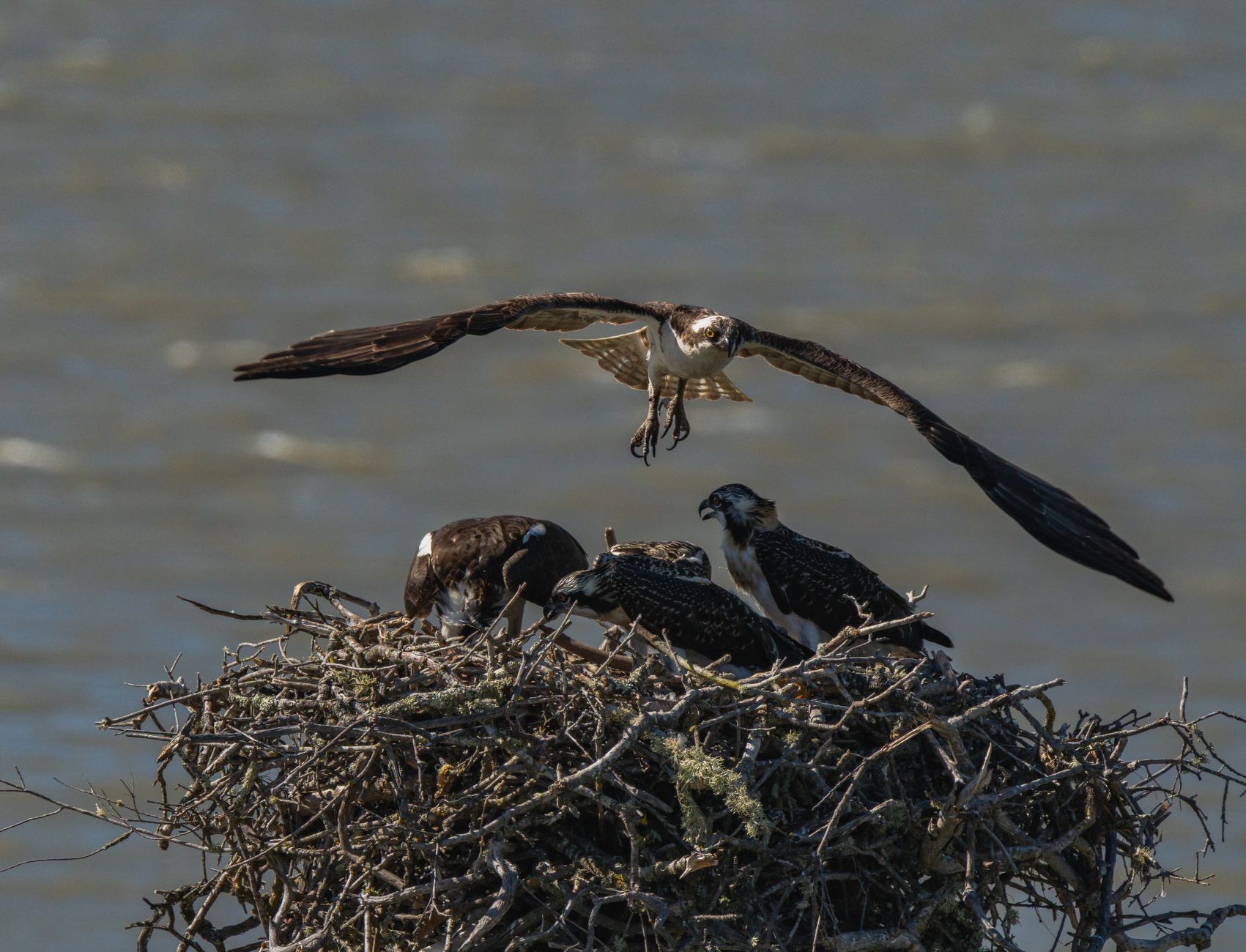
Juvenile ospreys leaving the nest near Wareham
Level
b2
Topic
environment
Read this at a different level:a1c1
Every summer, the wetlands and river valleys around Wareham become the focus of close attention from wildlife observers. This season, that attention has been well rewarded: the first juvenile osprey of the year has already left its nest, and three more are expected to follow before the season ends.
Ospreys were once nearly absent from much of England. By the late twentieth century, they had been pushed out of many of their traditional breeding areas by habitat loss and persecution. The recovery that has since been achieved has been remarkable, and sites near Wareham have become part of that broader conservation story. The nest from which this first juvenile has fledged is one that will have been monitored carefully throughout the breeding season — by wildlife organisations, volunteers, and enthusiastic members of the public alike.
Fledging is a significant moment in any young bird's life. Before the juvenile left the nest, it would have been exercising its wings for several weeks, building the muscle strength needed for sustained flight. The transition from nest to sky is not always smooth. Young ospreys must learn to hunt fish independently, a skill that cannot simply be inherited — it has to be developed through practice and, inevitably, failure. It is thought that survival rates in the first year are considerably lower than in later years, largely because hunting must be mastered without parental assistance.
Four juveniles are expected to fledge from the Wareham nest this season in total. Whether all four will complete their first migration successfully remains to be seen. Long-distance journeys to wintering grounds in West Africa will be undertaken by each bird alone. Nevertheless, the departure of the first juvenile has been welcomed as a positive sign — one that suggests the breeding season near Wareham has, so far, gone well.
Highlighted sentences show the grammar focus structure.
Key Vocabulary
juvenile
/ˈdʒuːvənaɪl/
A young animal or person who has not yet reached adulthood.
The wildlife centre was caring for a juvenile fox that had been found injured near the road.
persecution
/ˌpɜːrsɪˈkjuːʃən/
Cruel or unfair treatment of a person or group, often over a long period of time.
Many families fled the country to escape religious persecution.
remarkable
/rɪˈmɑːrkəbəl/
Unusual or impressive in a way that deserves attention and admiration.
She made a remarkable recovery after the surgery and was back at work within a month.
sustained
/səˈsteɪnd/
Continuing at the same level or rate for a long period without stopping or weakening.
The company achieved sustained growth over five years by investing heavily in new technology.
inevitably
/ɪnˈevɪtəbli/
In a way that is certain to happen and cannot be avoided.
If you don't prepare thoroughly for the exam, you will inevitably struggle on the day.
considerably
/kənˈsɪdərəbli/
To a large degree; much more or much less than expected.
The cost of living in the capital is considerably higher than in smaller towns.
migration
/maɪˈɡreɪʃən/
The movement of people or animals from one place to another, especially over a long distance.
The migration of workers from rural areas to cities has changed the country's population distribution significantly.
| Image | Word | IPA | Definition | Example |
|---|---|---|---|---|
juvenile | /ˈdʒuːvənaɪl/ | A young animal or person who has not yet reached adulthood. | The wildlife centre was caring for a juvenile fox that had been found injured near the road. | |
persecution | /ˌpɜːrsɪˈkjuːʃən/ | Cruel or unfair treatment of a person or group, often over a long period of time. | Many families fled the country to escape religious persecution. | |
remarkable | /rɪˈmɑːrkəbəl/ | Unusual or impressive in a way that deserves attention and admiration. | She made a remarkable recovery after the surgery and was back at work within a month. | |
sustained | /səˈsteɪnd/ | Continuing at the same level or rate for a long period without stopping or weakening. | The company achieved sustained growth over five years by investing heavily in new technology. | |
inevitably | /ɪnˈevɪtəbli/ | In a way that is certain to happen and cannot be avoided. | If you don't prepare thoroughly for the exam, you will inevitably struggle on the day. | |
considerably | /kənˈsɪdərəbli/ | To a large degree; much more or much less than expected. | The cost of living in the capital is considerably higher than in smaller towns. | |
migration | /maɪˈɡreɪʃən/ | The movement of people or animals from one place to another, especially over a long distance. | The migration of workers from rural areas to cities has changed the country's population distribution significantly. |
Grammar Spotlight
Passive Voice — All Common Tenses
be (in any tense) + past participle
When do we use it?
- Use the passive when the action itself matters more than who performs it — e.g. when the agent is unknown, obvious, or unimportant.
- Use it to maintain a formal or impersonal tone, common in academic writing, news reports, and scientific contexts.
- Use it to keep the focus on the subject being affected, especially when you want to connect ideas smoothly across sentences.
How is it formed?
be (am/is/are/was/were/will be/has been/have been/modal + be)+past participle
Change the tense of 'be' to shift the passive through time
★Same rule, every tense: be + past participle
See it in action
Every year, the wetlands around Wareham are visited by thousands of wildlife observers.
The first juvenile osprey of the season has already been spotted leaving its nest.
Three more young ospreys are expected to be released into the wild before autumn.
The nesting sites must be protected if the osprey population is to recover fully.
Remember this
Active Voice
- •Researchers have already observed the first juvenile osprey.
- •Wildlife teams will monitor the nesting sites all summer.
- •Authorities must protect the wetlands from development.
Passive Voice
- •The first juvenile osprey has already been observed.
- •The nesting sites will be monitored all summer.
- •The wetlands must be protected from development.
Switching to passive removes the agent and shifts focus onto what happened or what was affected — the tense of 'be' is the only thing that changes across all passive forms.
Discussion Questions
- 1.
In your country, are there any wild animals or birds that were once endangered but have made a comeback? What do you think made the recovery possible?
- 2.
To what extent do you think individuals — rather than governments or large organisations — can make a real difference to wildlife conservation? What examples from your own experience or your country come to mind?
- 3.
The article describes how young ospreys must learn to survive through practice and failure, without any parental help. How important do you think failure is as part of learning — in your own life or in the education system in your country?
- 4.
How might attitudes towards nature and wildlife differ between people who grow up in cities and those who grow up in rural areas? Which environment did you grow up in, and how do you think it shaped the way you see the natural world?
Comprehension Questions
- 1.
Why were ospreys once nearly absent from much of England, and what has changed since then?
- 2.
What does the article suggest about the challenges a juvenile osprey faces in its first year of life?
- 3.
How does the physical preparation described in paragraph three connect to the broader journey each juvenile osprey will eventually have to make?
- 4.
What might have happened to the osprey population near Wareham if conservation organisations and volunteers had not monitored the nests throughout the breeding season?
- 5.
To what extent does the article present the departure of the first juvenile as a cause for optimism, and what uncertainty remains?
View answers for the comprehension questions
- 1.Ospreys were pushed out of their traditional breeding areas by habitat loss and persecution. Since then, a remarkable recovery has taken place, and sites near Wareham have become part of this broader conservation success story.
- 2.The article suggests that the first year is particularly dangerous because young ospreys must learn to hunt fish entirely on their own, without parental help. Hunting is a skill that must be developed through practice and failure, which is why survival rates in the first year are considerably lower than in later years.
- 3.Before leaving the nest, juveniles spend several weeks building the muscle strength needed for sustained flight. This preparation is directly relevant to the long solo migration each bird will undertake to wintering grounds in West Africa, a journey that demands exactly the kind of endurance they are developing.
- 4.Without careful monitoring, threats to the nest — such as disturbance or predation — might have gone undetected, potentially reducing the number of juveniles that fledged successfully. The involvement of wildlife organisations and volunteers appears to have been an important factor in the positive outcome described in the article.
- 5.The article presents the first juvenile's fledging as a positive sign that the breeding season has gone well so far, and three more juveniles are expected to follow. However, significant uncertainty remains, as it is unclear whether all four birds will survive their first solo migration to West Africa.
Test your knowledge
Question 1Fill-in-the-blank
Training for a marathon requires ____ effort over many months, not just a few intense sessions close to race day.
Question 2Fill-in-the-blank
When you take on too many responsibilities at once, stress will ____ follow, no matter how well organised you are.
Question 3Fill-in-the-blank
The cost of living in the capital is ____ higher than in smaller towns, which makes it difficult for young people to afford housing there.
Question 4Fill-in-the-blank
Throughout history, minority groups have often faced ____ simply because of their background or beliefs, which has caused immense suffering.
Question 5Fill-in-the-blank
Given how little time she had to prepare, the quality of her presentation was truly ____.
View answers for test your knowledge
- 1.sustained
- 2.inevitably
- 3.considerably
- 4.persecution
- 5.remarkable
Practice this topic live
Use what you’ve learned in a real 1:1 English conversation with an experienced Talk4Impact tutor.
Practice with tutor