
Sunflower sea star conservation efforts in the Pacific Northwest
Level
c1
Topic
environment
Read this at a different level:b1b2
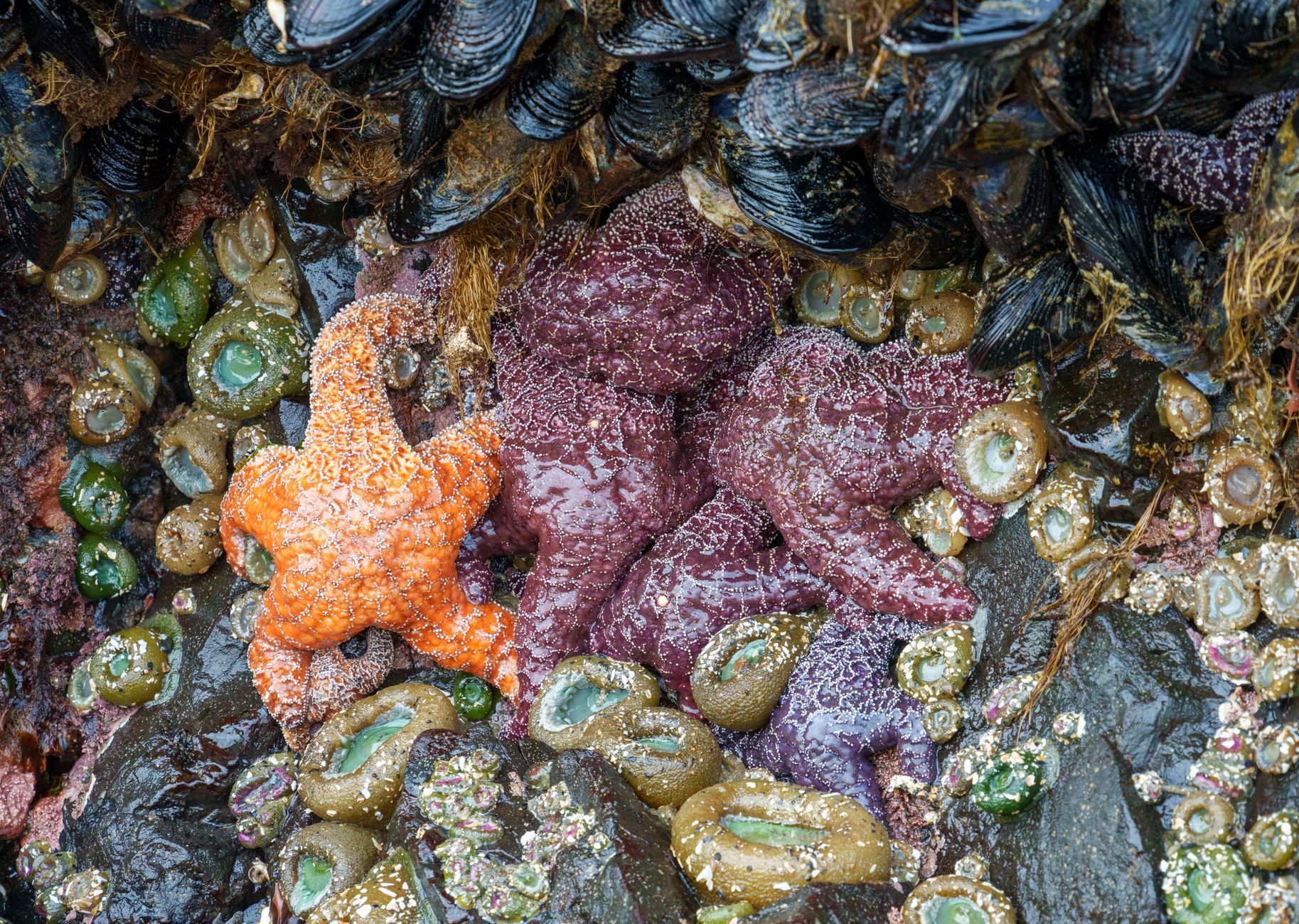
Most people picture a starfish as a modest five-armed creature clinging to a rock at low tide. The sunflower sea star, by contrast, commands twenty-four arms and can span nearly a metre across, making it one of the largest and most ecologically consequential invertebrates in the Pacific Ocean. What makes its near-disappearance so alarming is not merely the loss of a single species but the cascading disruption it has set in motion across an entire coastal ecosystem.
Billions of sunflower sea stars perished across the Pacific in recent decades, driven by a wasting disease whose spread was devastating in both speed and scale. The species is now listed as critically endangered — a designation that reflects not only diminished numbers but the practical difficulty of reversing a collapse of this magnitude. It is the sunflower sea star's role as a keystone predator that amplifies the urgency of its decline. Without it, populations of sea urchins have expanded unchecked, overgrazing the kelp forests that shelter a vast array of marine life. The loss of one predator, in other words, has reordered the trophic structure of an entire habitat.
Having identified the severity of this imbalance, researchers at the University of Washington are now working to restore the sunflower sea star population through active conservation programmes. Their work involves breeding individuals in controlled conditions and developing protocols that might eventually support reintroduction into the wild — a process that is expected to be painstaking and long-term. What the researchers have encountered, however, is not only a biological challenge but a logistical one: rebuilding a population that once numbered in the billions demands resources, coordination, and sustained institutional commitment.
Partnering in this effort is the Samish Indian Nation, whose involvement brings both ecological knowledge and a long-standing relationship with the coastal waters of the Pacific Northwest. This collaboration reflects a broader recalibration in conservation thinking, one that recognises Indigenous stewardship not as supplementary but as foundational. The Samish Nation's participation signals that the most durable restoration outcomes are likely to emerge from partnerships grounded in place-based knowledge rather than from laboratory science alone.
The fate of the sunflower sea star raises a question that extends well beyond the Pacific Northwest: at what point does ecological loss become irreversible? Taken together, the scale of the die-off, the disruption to kelp ecosystems, and the complexity of the recovery effort suggest that the window for meaningful intervention, though not yet closed, is narrowing. What remains to be seen is whether the institutional will to act matches the ecological urgency that the science so clearly articulates.
Highlighted sentences show the grammar focus structure.
Key Vocabulary
cascading
/kæˈskeɪdɪŋ/
Describing a series of events or effects in which each one triggers the next, producing a chain of consequences that grows progressively larger or more complex.
The bank's collapse had a cascading effect on financial markets worldwide, wiping out investor confidence within days.
keystone
/ˈkiːstoʊn/
Used attributively to describe a species, element, or principle that is so central to a system that its removal would cause the entire structure to fail or fundamentally change.
Trust is the keystone of any successful negotiation; without it, even the most carefully drafted agreements tend to collapse.
trophic
/ˈtroʊfɪk/
Relating to the feeding relationships and energy transfer between organisms at different levels of a food chain or ecological system.
The introduction of wolves into the national park dramatically altered the trophic dynamics, allowing vegetation to recover in areas previously stripped bare by deer.
painstaking
/ˈpeɪnzˌteɪkɪŋ/
Requiring or demonstrating extremely careful, thorough, and diligent effort, especially over a prolonged period.
The restoration of the medieval manuscript was a painstaking process that occupied a team of conservators for nearly three years.
recalibration
/ˌriːˌkælɪˈbreɪʃən/
A significant adjustment or reassessment of an approach, strategy, or set of values in response to new information or changed circumstances.
The election results prompted a fundamental recalibration of the party's economic messaging ahead of the next campaign.
stewardship
/ˈstuːərdʃɪp/
The responsible management and care of something entrusted to one's oversight, particularly natural resources, public assets, or cultural heritage.
The foundation praised the director's stewardship of the museum's collection, noting that acquisitions had doubled while conservation standards improved.
articulate
/ˈɑːrtɪkjuleɪt/
To express or communicate an idea, argument, or position clearly and with precision, particularly in a formal or persuasive context.
The report articulates a compelling case for reforming the pension system before demographic pressures make change unavoidable.
foundational
/faʊnˈdeɪʃənəl/
Serving as an essential, primary basis upon which something more complex is built or depends, rather than being merely supplementary or secondary.
Access to clean water is foundational to public health; no other medical intervention can compensate for its absence.
| Image | Word | IPA | Definition | Example |
|---|---|---|---|---|
cascading | /kæˈskeɪdɪŋ/ | Describing a series of events or effects in which each one triggers the next, producing a chain of consequences that grows progressively larger or more complex. | The bank's collapse had a cascading effect on financial markets worldwide, wiping out investor confidence within days. | |
keystone | /ˈkiːstoʊn/ | Used attributively to describe a species, element, or principle that is so central to a system that its removal would cause the entire structure to fail or fundamentally change. | Trust is the keystone of any successful negotiation; without it, even the most carefully drafted agreements tend to collapse. | |
trophic | /ˈtroʊfɪk/ | Relating to the feeding relationships and energy transfer between organisms at different levels of a food chain or ecological system. | The introduction of wolves into the national park dramatically altered the trophic dynamics, allowing vegetation to recover in areas previously stripped bare by deer. | |
painstaking | /ˈpeɪnzˌteɪkɪŋ/ | Requiring or demonstrating extremely careful, thorough, and diligent effort, especially over a prolonged period. | The restoration of the medieval manuscript was a painstaking process that occupied a team of conservators for nearly three years. | |
recalibration | /ˌriːˌkælɪˈbreɪʃən/ | A significant adjustment or reassessment of an approach, strategy, or set of values in response to new information or changed circumstances. | The election results prompted a fundamental recalibration of the party's economic messaging ahead of the next campaign. | |
stewardship | /ˈstuːərdʃɪp/ | The responsible management and care of something entrusted to one's oversight, particularly natural resources, public assets, or cultural heritage. | The foundation praised the director's stewardship of the museum's collection, noting that acquisitions had doubled while conservation standards improved. | |
articulate | /ˈɑːrtɪkjuleɪt/ | To express or communicate an idea, argument, or position clearly and with precision, particularly in a formal or persuasive context. | The report articulates a compelling case for reforming the pension system before demographic pressures make change unavoidable. | |
foundational | /faʊnˈdeɪʃənəl/ | Serving as an essential, primary basis upon which something more complex is built or depends, rather than being merely supplementary or secondary. | Access to clean water is foundational to public health; no other medical intervention can compensate for its absence. |
Grammar Spotlight
Cleft Sentences
It is / was + [focus] + that / who + [rest of clause]
When do we use it?
- Use cleft sentences to place emphatic focus on one specific element — subject, object, time, or reason — that you want the listener or reader to notice above all else.
- They are especially effective in formal writing and spoken argument to correct a mistaken assumption or to contrast one piece of information with another ('It was the sea urchin population, not the kelp, that collapsed first.').
- At C1 level, clefts signal sophisticated control of information structure — use them to guide your reader's attention rather than simply stating facts in neutral word order.
How is it formed?
It is / was+[focused element]+that / who + [remainder of clause]
Use 'who' when the focused element is a person; 'that' for everything else
★Split the clause — spotlight what matters most.
See it in action
It is the sunflower sea star that plays the most critical role in controlling sea urchin populations.
It was the sudden spread of sea-star wasting disease that devastated sunflower sea star numbers across the Pacific.
It is their extraordinary span of nearly a metre that makes sunflower sea stars so ecologically consequential.
It was not five arms but twenty-four that distinguished this remarkable invertebrate from the starfish most people picture.
Remember this
✗It is the sunflower sea star which controls sea urchin populations.
✓It is the sunflower sea star that controls sea urchin populations.
In cleft sentences, 'that' is strongly preferred over 'which' in both formal and informal registers; 'which' sounds unnatural here and is widely considered an error.
✗It is the scientists who they discovered the collapse of the sea star population.
✓It is the scientists who discovered the collapse of the sea star population.
After the relative clause opener 'who' in a cleft, do not repeat the subject pronoun — the relative pronoun already fills that role.
✗It was in the Pacific where the sunflower sea star once thrived.
✓It was in the Pacific that the sunflower sea star once thrived.
Even when the focused element is a place, use 'that' — not 'where' — in a standard it-cleft construction.
Discussion Questions
- 1.
In your country, are there any well-known examples of a single species or environmental change that had a dramatic knock-on effect on the wider ecosystem or landscape? What happened, and how did people respond to it?
- 2.
The article argues that Indigenous communities bring foundational knowledge to conservation efforts, rather than merely supplementary input. To what extent do you think traditional or community-based knowledge is valued in environmental decision-making in your country, and do you believe that balance is right?
- 3.
At what point, in your view, does it become ethically justifiable to abandon the effort to save a critically endangered species and redirect resources elsewhere? What criteria would you use to make that judgement?
- 4.
Think about the natural environment near where you grew up or currently live — a coastline, a forest, a river, or even a city park. Have you noticed any changes to it over the years, and how do you feel about those changes personally?
Comprehension Questions
- 1.
Why is the sunflower sea star's decline considered more serious than the loss of an ordinary species?
- 2.
What specific biological and logistical challenges have researchers encountered in their efforts to restore the sunflower sea star?
- 3.
How does the article characterise the role of the Samish Indian Nation in the conservation effort, and what broader shift in thinking does their involvement represent?
- 4.
Is the article's overall tone optimistic or cautionary about the prospects for recovery, and what evidence from the text supports your reading?
- 5.
What connection does the article draw between the collapse of the sunflower sea star population and the condition of kelp forest ecosystems?
View answers for the comprehension questions
- 1.The sunflower sea star functions as a keystone predator, meaning its removal fundamentally disrupts the entire ecosystem around it. Without it, sea urchin populations have expanded unchecked, overgrazing kelp forests and thereby dismantling the habitat that supports a wide range of marine life.
- 2.On the biological side, researchers must breed individuals in controlled conditions and develop protocols for eventual reintroduction into the wild, a process expected to be painstaking and long-term. Logistically, rebuilding a population that once numbered in the billions demands enormous resources, coordination across institutions, and sustained commitment over time.
- 3.The article presents the Samish Indian Nation not as a supplementary partner but as a foundational one, bringing place-based ecological knowledge and a long-standing relationship with the Pacific Northwest coastline. Their involvement reflects a broader recalibration in conservation thinking that recognises Indigenous stewardship as central rather than peripheral to achieving durable restoration outcomes.
- 4.The tone is cautionary rather than optimistic. While the article acknowledges that the window for meaningful intervention has not yet closed, it emphasises that this window is narrowing and questions whether institutional will can match the ecological urgency the science articulates, suggesting that a positive outcome is uncertain rather than assured.
- 5.The article explains that the sunflower sea star kept sea urchin populations in check, and its disappearance allowed those populations to expand unchecked. The resulting overgrazing by sea urchins has destroyed kelp forests, which in turn has eliminated the shelter and habitat that a vast array of other marine species depends upon.
Test your knowledge
Question 1Fill-in-the-blank
The professor was able to ____ her position on the policy reform so clearly that even those who disagreed with her found it difficult to challenge her reasoning.
Question 2Fill-in-the-blank
The documentary explained the ____ relationships in the rainforest, showing how energy moves from plants to insects to larger animals at each level of the food chain.
Question 3Fill-in-the-blank
The new director took her ____ of the community centre seriously, ensuring the building was well maintained and its programmes remained accessible to everyone.
Question 4Fill-in-the-blank
Trust is a ____ element in any successful team; once it is lost, the entire working relationship tends to break down rapidly.
Question 5Fill-in-the-blank
After receiving feedback from users, the design team undertook a thorough ____ of their priorities, shifting their focus away from visual appeal and towards accessibility.
View answers for test your knowledge
- 1.articulate
- 2.trophic
- 3.stewardship
- 4.keystone
- 5.recalibration
Practice this topic live
Use what you’ve learned in a real 1:1 English conversation with an experienced Talk4Impact tutor.
Practice with tutor